


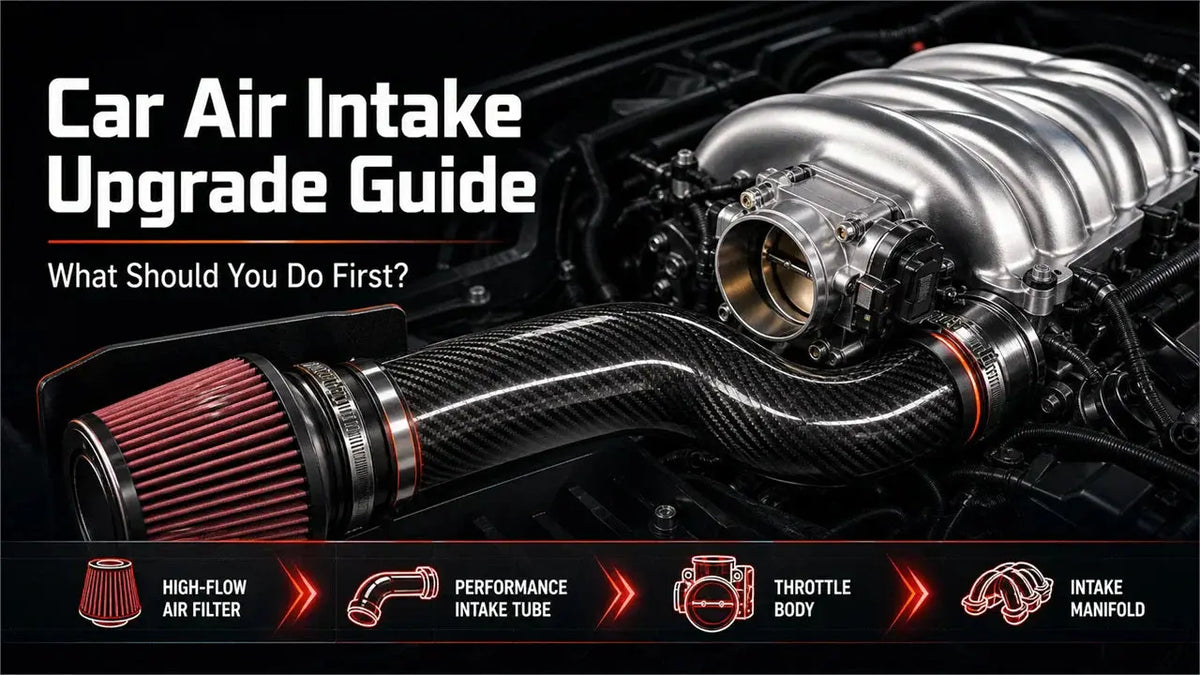
Direct Answer
When upgrading your car's air intake system, always prioritize modifying the specific component that limits your current engine combination's airflow, rather than blindly purchasing the largest advertised parts. A scientific upgrade process begins with basic maintenance and leak checks, followed by tailoring a plan based on your exact engine model, target RPM range, engine bay layout, and tuning strategy. Stock vehicles typically benefit most from starting at the upstream intake front-end (such as high-flow panel filters or cold air intakes). Conversely, heavily modified or stroked engines require a coordinated, systematic overhaul of the intake manifold, throttle body, cylinder heads, camshaft, and fuel system.
Key Takeaways
- Maintenance First: Always repair a dirty, leaking, damaged, or incorrectly installed factory system before buying aftermarket upgrades.
- Goal-Oriented Upgrades: Choose your entry point based on your primary objective: serviceability, intake sound, engine bay packaging, low-end throttle response, or high-RPM airflow.
- Scope of Impact: Swapping an air filter or cold air intake kit has a significantly narrower scope of impact than upgrading cylinder heads or an intake manifold.
- The Domino Effect: High-performance cylinder heads directly alter compression ratios, valvetrain geometry, exhaust requirements, and overall ECU tuning calibration.
- Account for Hidden Costs: Budget sufficiently for supporting components (gaskets, fuel rails, fittings) rather than focusing solely on the price of the headline part.
Define Your Actual Goal
Before comparing hardware, you must clearly define your primary objective. A daily-driven truck seeking easy filter maintenance should not be planned like a high-RPM, race-spec LS build. Pinpointing your target helps you select the right hardware:
- Replace a worn or contaminated factory component to restore baseline performance.
- Improve engine air filter serviceability and transition to a reusable media.
- Change the intake sound to achieve a more aggressive, throatier induction note.
- Eliminate a known high-RPM intake restriction or airflow bottleneck.
- Support a larger-displacement, high-lift camshaft (Big Cam), or forced induction (turbocharger/supercharger) combination.
- Convert between drive-by-cable (mechanical) and drive-by-wire (electronic) throttle control strategies.
- Properly package an EFI or carbureted system into an engine swap project.

Upgrade Selection Matrix
| Upgrade | Best First Choice When | Check Before Buying | Supporting Work |
|---|---|---|---|
| Performance Filter | Factory filter is due for replacement, damaged, or incorrectly sized. | OEM cross-reference numbers, exact physical dimensions. | Inspect the factory air box and housing seals. |
| Cold Air Intake (CAI) | A verified vehicle-specific kit fits, and your goal includes inlet path optimization, serviceability, or aggressive sound. | Exact model year, engine family, MAF/MAP sensor provisions, breather routing. | Inspect installation clearance; some vehicles may require an ECU relearn/recalibration. |
| Throttle Body | The factory unit is faulty, incompatible with a swap, or dyno-proven to be a definitive airflow restriction. | Bore diameter, actuation (cable vs. electronic), connector pinouts, TPS/IAC hardware, bolt pattern. | May require an adapter flange or immediate ECU calibration. |
| Intake Manifold | The current manifold does not match the cylinder head ports, fuel system type, hood clearance, or target operating RPM range. | Engine family, port shape, EFI vs. carbureted layout, overall height, fuel rail compatibility. | Replace gaskets and fasteners; adjust fuel system plumbing and ECU tuning map. |
| Cylinder Heads | The entire build strategy demands a coordinated increase in airflow volume alongside a compression ratio change. | Engine block casting, cylinder bore size, combustion chamber volume, port shapes, valve/spring specs. | Match the camshaft, pushrods, exhaust headers, fasteners, and complete custom tune. |
Deep Dive: Critical Intake Upgrades Explained
1. Should a Stock Vehicle Start with a Replacement Filter or a Cold Air Intake (CAI)?
Before making any modifications, perform a thorough health inspection of your factory setup. If the filter is loaded with debris or the ducting is cracked, prioritize restoring it to healthy working order. If the factory air box and inlet tube are pristine, installing a premium high-flow drop-in replacement panel filter is the lowest-complexity, most cost-effective route. You can refer to our Engine Air Filter Types, Fitment, and Replacement Guide for specific media selection advice.
A vehicle-specific cold air intake kit alters the upstream intake path much more thoroughly. When shopping, closely evaluate the kit’s filter style, heat shield design, sensor mounts, breather tube routing, and potential weather or water exposure. Never assume a kit designed for a similar model year or engine size will fit seamlessly; check the details in our guide on Cold Air Intake Kit Fitment and Installation Considerations. Furthermore, understanding how Car Air Intake System Components Work Together will help you realize how upstream upgrades affect the overall engine airflow.

2. When is a Throttle Body Upgrade the Right First Step?
Upgrading your throttle body only makes sense when the factory unit has suffered a mechanical or electrical failure, cannot integrate with an engine swap project, or has been verified as a true airflow bottleneck.
It is critical to note that mechanical cable-driven and electronic drive-by-wire (DBW) throttle bodies cannot be treated interchangeably just because they share a similar bore diameter. Throttle cable brackets, IAC (Idle Air Control) passages, TPS (Throttle Position Sensor) hardware, ECU control logic, accelerator pedal assemblies, wiring harness pinouts, and manifold bolt patterns dictate the success of this swap. For a detailed breakdown of control strategies and LS engine swaps, see our Throttle Body Size, Fitment, and DBW vs. Cable Guide for LS Engines.
Tech Warning: If your intake manifold neck opening, runner volume, cylinder heads, camshaft, or ECU tune remain a physical restriction, an oversized throttle body will yield no measurable power gains. In fact, it may even make low-throttle tip-in response overly sensitive and difficult to modulate smoothly.

3. When Should You Swap the Intake Manifold?
You should change the intake manifold when its port family, fuel system delivery type, throttle flange configuration, physical engine bay packaging, or optimal RPM operating range no longer aligns with your engine build. The design of the manifold's runners and plenum directly dictates where the engine maximizes air velocity and torque; you can learn about the fluid dynamics behind these designs in Intake Manifold Runners and Plenums: EFI vs. Carbureted Systems.
Because port designs differ inherently across engine families (for instance, the LS platform splits sharply between cathedral-port and rectangular-port configurations), strict verification is mandatory. To safely navigate this, check our comprehensive LS Intake Compatibility Guide: Cathedral vs. Rectangular Ports.
Technical Clearances: Your total hood clearance calculations must account for the combined stack height of the intake manifold, throttle body or carburetor, spacers, fuel rails, plumbing fittings, and the air cleaner assembly. For example, the EVIL ENERGY carbureted manifold listed under part number 4023 is engineered exclusively for the Ford 351W (5.8L) engine family. It cannot be used on Ford 302, 351C, or 351M/400 blocks. If you are unsure where your combination stands, consult What Intake Upgrade Should You Do First?

4. When are High-Performance Cylinder Heads the Correct Starting Point?
Cylinder heads are typically part of a meticulously planned top-end overhaul or a complete ground-up engine build, rather than an isolated first purchase. Combustion chamber volume directly alters the compression ratio; runner and valve dimensions govern raw airflow and velocity; and spark plug angles dictate exhaust header clearance. If purchasing bare castings, you must source a matching valvetrain package and perform professional machine assembly. For technical selection parameters, explore our Cylinder Head Selection Guide: LS, SBC, and BBC Runner and Chamber Sizes.
When ordering EVIL ENERGY components, double-check the distinctions between LS1 cathedral-port, SBC (Small Block Chevrolet), and BBC (Big Block Chevrolet) architectures. Always verify if the listing specifies bare castings versus complete assemblies with springs, and whether the pricing reflects a single cylinder head or a matched pair.
To squeeze every ounce of performance out of your engine seamlessly, review our deep dive on How to Match Cylinder Heads, Intake Manifolds, Throttle Bodies, and Cams to ensure your entire induction path is perfectly balanced.
Hidden Costs of Intake Modifications
- Seals & Hardware: Performance intake manifold gaskets, specialized seals, high-strength bolts, studs, adapter plates, and vacuum line fittings.
- Fuel Delivery: Aftermarket fuel rails, larger fuel injectors, braided lines, external fuel pressure regulators, or carburetor linkages.
- Electronics & Controls: New sensors (MAP/MAF), harness adapter looms, electronic gas pedals, or mechanical throttle cable brackets.
- Valvetrain (For Cylinder Heads): Correct-length pushrods, rocker arms, performance valve springs, retainers, and professional machining/assembly labor.
- Clearance Alterations: Modifications needed to clear the hood, accessory drive brackets, coolant hoses, PCV systems, and brake booster vacuum ports.
- Calibration Support: Custom ECU flashing software, dyno rental time, and professional tuner labor fees.
FAQs
Q: Is a high-performance air filter the cheapest intake upgrade?
A: Generally, yes. However, it must still precisely match your factory air box's dimensions and your intended maintenance routine (dry vs. oiled). Price alone does not guarantee superior airflow, filtration efficiency, or seamless fitment.
Q: Should I install a larger throttle body before replacing the intake manifold?
A: Only if your current manifold can accept the larger bore diameter without a massive airflow lip, and the throttle body solves a documented bottleneck. If you plan to change the manifold later, it is highly recommended to select both components together, matching the same port architecture, flange layout, and target airflow strategy.
Q: Is it worth upgrading cylinder heads if I keep the stock camshaft?
A: That depends entirely on the specific engine platform and your ultimate goals. The cylinder heads, camshaft profile, compression ratio, exhaust hot-side, fuel delivery, and tuning map must be evaluated as a single collective system. There are no universal 'one-size-fits-all' shortcuts.
Q: Can I install an intake upgrade without a custom tune?
A: Basic upstream kits, such as standard cold air intakes, can run safely on a factory calibration if the product documentation explicitly states it is designed to do so. However, major structural alterations to the throttle body, intake manifold, cylinder heads, injectors, or camshaft universally demand a comprehensive ECU calibration review.
Q: What is the safest first step when starting a build?
A: Carefully document your current engine specifications, sensor configurations, part numbers, exact physical measurements, baseline diagnostic live-data logs, and ultimate performance goal. Then, select the smallest, verified hardware modification that directly resolves your current primary bottleneck.


