![[20FT] EVIL ENERGY PTFE Fuel Line Kit, complete black hose & fittings set, 180-day return](http://www.ievilenergy.com/cdn/shop/files/Test-2025-Evilenergy-125598065_940x.png?v=1742144807)
![[16FT] EVIL ENERGY PTFE Fuel Line Kit, black braided hose, fittings, free shipping & return](http://www.ievilenergy.com/cdn/shop/files/Test-2025-Evilenergy-125598171_940x.png?v=1742144807)
![CPE Fuel Line[25FT]](http://www.ievilenergy.com/cdn/shop/files/25FTCPE_FuelLine_940x.png?v=1735220649)
![CPE Fuel Line[20FT]](http://www.ievilenergy.com/cdn/shop/files/20FTCPE_FuelLine_940x.png?v=1735220649)





Throttle Body Guide: How It Works, DBW vs Cable, Sizing, Cleaning, and LS Fitment

🎁 A Personal Gift For My Readers
To support your project, I've secured an exclusive 8% OFF for you.
Simply paste the code at checkout.
💡 Use the savings to grab your extra fittings, oil lines, or connectors for free!
A throttle body controls how much air enters the intake manifold, but selecting or diagnosing one requires more than checking the advertised bore diameter. Control type, bolt pattern, manifold opening, electrical connector, throttle-position sensing, idle-control strategy, ECU support, intake-tube size, and calibration must all work together.
This guide explains how mechanical cable and drive-by-wire throttle bodies operate, how to evaluate common 85 mm, 90 mm, 92 mm, and 102 mm sizes, what must match on an LS-based build, and how a professional technician separates throttle deposits from vacuum leaks, sensor faults, wiring problems, and calibration issues.
Quick Answer
A throttle body uses a rotating throttle plate to regulate airflow into the intake manifold. Select one by confirming the engine and manifold family, control type, flange and bolt pattern, throttle opening, connector, TPS and IAC requirements, pedal and ECU compatibility, intake-tube connection, and calibration support.
Do not assume that a 92 mm or 102 mm label confirms fitment. It describes only one dimension and does not confirm the mounting pattern, electrical system, included sensors, manifold transition, or whether the rest of the engine can use the additional airflow.
When diagnosing a suspected dirty or failed throttle body, scan for codes and inspect the complete air-intake system before cleaning or replacing parts. Electronic throttle bodies must be serviced according to the vehicle-specific procedure because improper plate movement, solvent exposure, connector damage, or an incomplete relearn can create additional faults.
Key Takeaways
- Mechanical and drive-by-wire throttle bodies require different pedals, wiring, sensors, idle-control strategies, and ECU support.
- A listed bore diameter does not confirm the bolt pattern, flange, connector, TPS, IAC, manifold opening, or intake-tube fitment.
- 85 mm, 90 mm, 92 mm, and 102 mm throttle bodies are application sizes, not automatic upgrade stages.
- A larger throttle body cannot correct restrictive cylinder heads, an unsuitable intake manifold, a small inlet tube, poor fuel delivery, or incorrect tuning.
- Adapters can solve a physical flange difference but cannot solve electronic, pedal, sensor, idle-control, or calibration incompatibility.
- Rough idle and hesitation are not proof of throttle-body contamination; vacuum leaks, MAF faults, ignition problems, fuel issues, wiring faults, and calibration errors can produce similar symptoms.
- Some vehicles require a throttle or idle relearn after cleaning, replacement, battery disconnection, or ECU programming.
How Does a Throttle Body Work?
The throttle body is positioned between the intake tube and the intake manifold on most gasoline EFI systems. A round or oval throttle plate rotates inside the bore. As the plate opens, the available airflow area increases. As it closes, the airflow path becomes more restricted.
The throttle body does not independently set the air-fuel ratio. It regulates airflow, while the ECU uses sensor data and its calibration to command fuel delivery, ignition timing, idle control, and other engine functions.
To understand how the throttle body works with the air filter, intake tube, MAF or MAP sensor, intake manifold, cylinder heads, and valves, see the car air intake system components guide.
Cable-Controlled Throttle Body Operation
On a mechanical throttle body, the accelerator pedal pulls a cable connected to a throttle lever. The lever rotates the throttle shaft and plate. A return spring closes the plate when pedal pressure is released.
Many cable systems also use:
- A throttle-position sensor, or TPS, to report throttle angle to the ECU.
- An idle-air-control valve or motor, commonly called an IAC, to bypass a controlled amount of air around the closed throttle plate.
- A throttle cable bracket with correct cable alignment and travel.
- A separate cruise-control cable on some applications.
- Mechanical stops and return springs that must not be modified without the correct procedure.
Drive-by-Wire Throttle Body Operation
A drive-by-wire system has no direct mechanical cable between the accelerator pedal and throttle plate. Accelerator-pedal position sensors send a request to the ECU. The ECU commands an electric throttle actuator while monitoring redundant pedal and throttle-position signals.
The ECU may limit or modify throttle opening according to engine speed, traction control, transmission operation, temperature, diagnostic status, and the programmed torque-management strategy. For this reason, a DBW throttle body is part of a coordinated electronic safety system rather than simply an electric substitute for a cable throttle body.
What Is the Difference Between DBW and Cable Throttle Bodies?

| Fitment Check | Mechanical / Cable | Electronic / Drive-by-Wire |
|---|---|---|
| Pedal connection | Physical throttle cable and correctly positioned bracket | Compatible electronic accelerator-pedal module |
| Throttle movement | Pedal and cable rotate the throttle lever directly | ECU commands an internal electric actuator |
| Idle control | Often uses a separate IAC passage or motor | Usually controlled through commanded throttle-plate movement |
| Position sensing | A separate TPS may be installed or required | Usually uses integrated redundant throttle-position sensors |
| ECU requirements | Requires a cable-compatible ECU strategy and correct TPS/IAC configuration | Requires a matching ECU, pedal, wiring, connector, sensor logic, and calibration |
| Common swap concern | Cable travel, bracket geometry, return spring, TPS, and IAC compatibility | Pedal and ECU mismatch, connector or pinout differences, correlation faults, and calibration |
| Visual similarity | Similar bore sizes or four-bolt flanges do not make the two control systems interchangeable. | |
Product Configuration Example
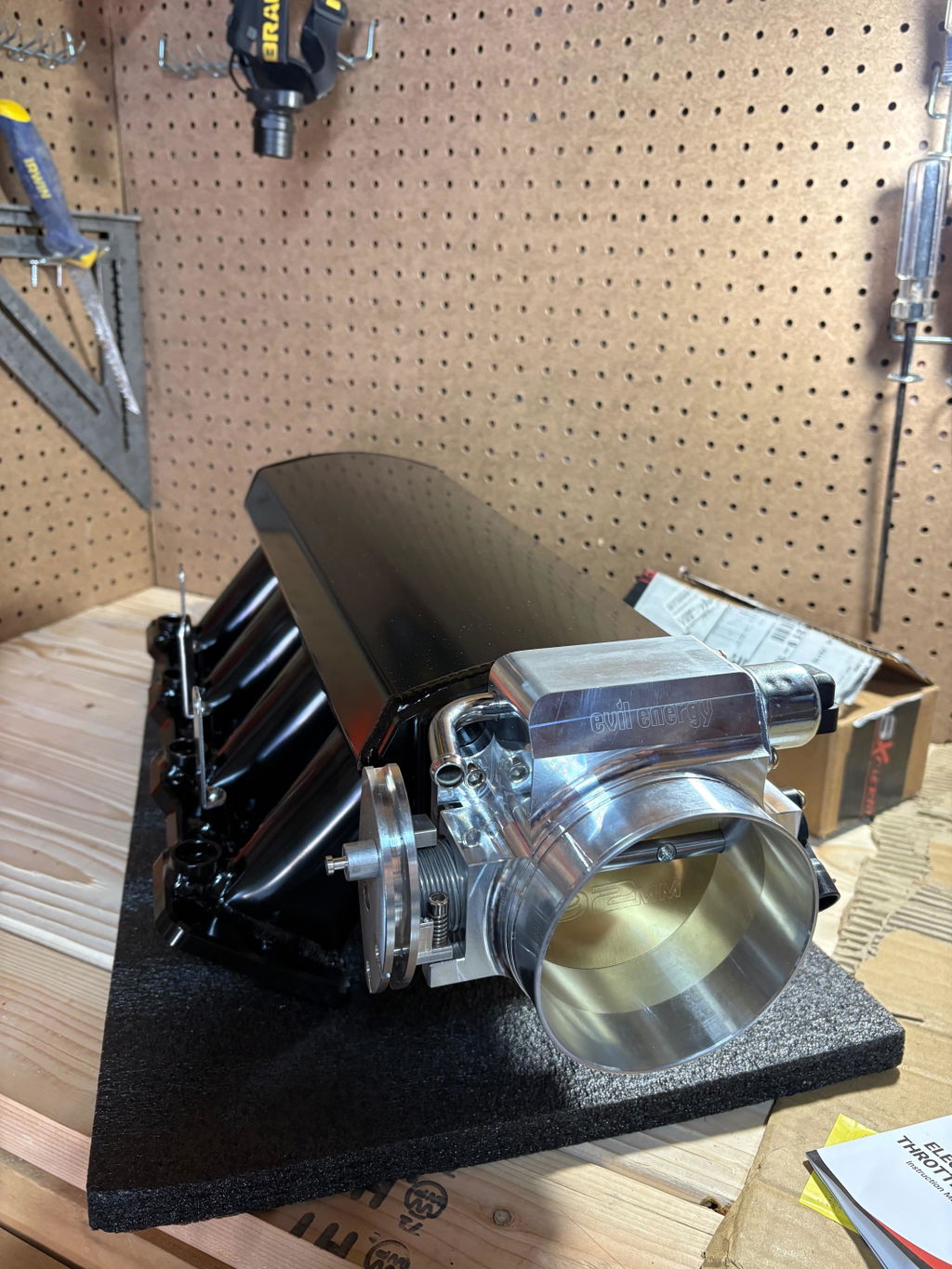
Two 92 mm throttle bodies can share the same advertised bore size while using completely different control systems and included components. For example, an EVIL ENERGY mechanical throttle body may include an IAC motor while requiring a separate TPS. By comparison, an electronic drive-by-wire version may use a six-pin connector with integrated throttle-position sensing and control idle airflow through the throttle actuator rather than a separate IAC motor.
Always review the specifications for the exact variant before ordering. Bore size alone does not confirm sensor inclusion, connector type, idle-control strategy, wiring compatibility, or ECU requirements.
Is Drive-by-Wire Better Than Cable?
Neither control type is universally better.
A cable system may simplify an older chassis or custom swap when the ECU is already configured for mechanical throttle control. However, cable alignment, pedal travel, return spring operation, and IAC/TPS compatibility still require careful setup.
A DBW system can provide coordinated idle control, cruise control, traction control, torque management, and transmission integration. Its success depends on using a compatible ECU, pedal assembly, throttle body, wiring harness, connector, and calibration.
How Do You Choose Throttle-Body Size?
Choose throttle-body size according to the complete engine combination and verified airflow requirement, not by selecting the largest available diameter.
Evaluate:
- Engine displacement.
- Expected operating RPM range.
- Naturally aspirated, supercharged, or turbocharged operation.
- Intake-manifold inlet diameter and bolt pattern.
- Runner and plenum design.
- Cylinder-head airflow and port family.
- Camshaft and valvetrain combination.
- Current throttle body as a measured or tested restriction.
- Intake-tube diameter, bends, couplers, and filter area.
- Low-speed pedal control and throttle tip-in sensitivity.
- ECU airflow limits, throttle mapping, and tuning support.
For more information about how runner length and plenum volume affect the useful RPM range, read the intake manifold runner, plenum, EFI, and carbureted-system guide.
What Do 85 mm, 90 mm, 92 mm, and 102 mm Mean?
| Nominal Size | What to Remember |
|---|---|
| 85 mm | The diameter does not identify the engine family. Many 85 mm products are designed for specific vehicle and electronic-control applications. |
| 90 mm | A common performance size, but its flange, connector, throttle plate, and calibration may differ from another 90 mm product. |
| 92 mm | Common in aftermarket LS-related listings. Mechanical and electronic 92 mm products are not interchangeable. |
| 102 mm | Requires a compatible manifold opening, flange, intake transition, control system, and engine combination capable of using the additional area. |
Also confirm what the manufacturer is measuring. The advertised number may describe the throttle-plate diameter, internal opening, or another product dimension. The inlet outside diameter used by the intake coupler may be different.
Why Bigger Is Not Automatically Better
A 102 mm throttle body cannot create a complete 102 mm airflow path when the manifold opening, adapter, intake tube, filter, or cylinder-head flow capacity remains smaller. A sharp step between components can also create a poor transition even when the parts physically bolt together.
On some combinations, an unnecessarily large throttle body can make low-pedal airflow changes more abrupt. The result may feel like sensitive tip-in rather than a meaningful increase in usable engine output.
If you are deciding where to spend the upgrade budget, use the filter, cold air intake, throttle body, manifold, and cylinder-head upgrade guide to identify the actual restriction before replacing parts.
What Must Match on an LS Throttle Body?
Labels such as LS1, LS2, LS3, LS6, LS7, LSX, or 'LS compatible' are not enough to confirm throttle-body fitment. Swapped vehicles frequently combine an engine, intake manifold, wiring harness, ECU, pedal, accessory drive, and intake tube from different applications.
- Control type: Confirm mechanical cable or electronic drive-by-wire operation before checking anything else.
- Mounting flange and bolt pattern: Verify bolt count, bolt spacing, flange shape, gasket shape, and mounting orientation against the installed manifold.
- Manifold inlet opening: Make sure the throttle plate can open without interference and that the inlet transition does not create a severe step.
- Electrical connector: Match the connector shape, terminal arrangement, pinout, sensor design, and ECU strategy. A connector that appears similar does not prove electrical compatibility.
- TPS and IAC requirements: Determine whether the product includes these components and whether the ECU and harness expect separate or integrated control.
- Pedal and ECU: A DBW throttle body must operate with a compatible accelerator pedal, ECU, wiring harness, and software calibration.
- Cable geometry: For a mechanical system, confirm bracket position, cable end, travel, alignment, return spring operation, and full opening without cable over-travel.
- Intake-tube connection: Measure the throttle-body inlet outside diameter rather than assuming that the advertised bore equals the coupler size.
- Clearance: Check the throttle motor, cable lever, connector, intake tube, hood, radiator hose, accessory drive, and firewall clearance.
- Calibration: Verify whether the ECU requires idle relearn, throttle relearn, airflow-model changes, pedal-map adjustments, or custom tuning.

Where Do Cathedral and Rectangular Ports Matter?
The cylinder-head port shape does not normally determine the throttle-body connector directly, but it determines which intake manifold family can be used. That manifold then determines the throttle flange, opening, fuel-rail arrangement, height, and other packaging requirements.
Before mixing LS1-style cathedral-port parts with LS3-style rectangular-port parts, review the LS cathedral-port and rectangular-port intake compatibility guide.
Can an Adapter Make Any Throttle Body Fit?
No. An adapter may connect two physical flange patterns or transition between different openings. It does not make the pedal, TPS, IAC, throttle motor, connector, ECU logic, wiring, or calibration compatible.
An adapter can also increase overall length and change intake-tube, hood, fan, or radiator clearance. Inspect the complete installed position rather than evaluating the adapter on a workbench alone.
Professional Diagnostic Process for Throttle-Body Problems

A professional diagnosis should begin before the intake tube is removed or cleaner is applied. Cleaning a throttle body without confirming the fault can temporarily change symptoms while leaving the actual cause unresolved.
Step 1: Verify the Customer Concern
Confirm when the symptom occurs:
- Cold start or hot restart.
- Idle in Park or Drive.
- Light throttle or wide-open throttle.
- Deceleration or coming to a stop.
- After battery disconnection, intake work, tuning, or throttle-body replacement.
- Only with air conditioning or electrical load applied.
Step 2: Scan for Codes and Review Data
Record current, pending, and history codes before clearing anything. When supported by the scan tool, review:
- Accelerator-pedal position sensor signals.
- Throttle-position sensor 1 and 2 signals.
- Commanded and actual throttle angle.
- MAF airflow or MAP pressure.
- Short-term and long-term fuel trims.
- Commanded and actual idle speed.
- Battery and charging voltage.
- Freeze-frame conditions.
A code such as a throttle-position correlation fault should be diagnosed with service information and live data. It is not automatic proof that deposits are present or that the entire throttle body must be replaced.
Step 3: Inspect the Upstream Intake
Check the air filter, air box, intake tube, clamps, couplers, resonators, MAF seal, breather connections, and PCV plumbing. Look for:
- Split or collapsed intake tubing.
- Loose clamps or couplers.
- Disconnected breather hoses.
- Dust trails indicating an air-filter or coupler sealing problem.
- Oil contamination around the MAF or throttle inlet.
- Aftermarket sensor placement that disturbs airflow readings.
Step 4: Check for Unmetered-Air and Vacuum Leaks
Inspect the throttle-body gasket, intake-manifold seals, brake-booster hose, PCV system, injector seals, vacuum fittings, and unused ports. A smoke test is often more reliable than replacing parts based on idle symptoms alone.
Step 5: Inspect the Control System
For cable systems, check cable slack, bracket alignment, full travel, binding, return-spring operation, cruise-control linkage, TPS mounting, and IAC passages.
For DBW systems, inspect the throttle connector, accelerator-pedal connector, wiring condition, terminal tension, grounds, charging voltage, and ECU compatibility. Do not test terminals with methods that could spread or damage them.
Step 6: Inspect the Throttle Bore and Plate
Look for heavy deposits at the closed-plate area, physical damage, excessive shaft play, plate contact with the bore, corrosion, coolant leakage where applicable, or evidence that the stop screw has been altered.
Step 7: Clean Only When Supported by the Inspection
Use the cleaner and procedure approved for the vehicle or product. Do not immerse electronic components, flood the actuator housing, scrape machined surfaces, or assume every factory bore coating should be removed.
Step 8: Relearn, Road Test, and Recheck
Perform the required throttle or idle relearn, clear codes only when appropriate, and complete a road test under the conditions that originally produced the symptom. Recheck fuel trims, commanded versus actual throttle position, idle stability, and diagnostic codes.
What Are Common Dirty Throttle Body Symptoms?
Deposits around the throttle plate can change the small airflow area used near closed throttle. Depending on the vehicle and control strategy, this may contribute to:
- Unstable or lower-than-expected idle.
- Higher-than-expected idle after cleaning or battery disconnection.
- Stalling when coming to a stop.
- Delayed response from a closed-throttle position.
- Light-throttle hesitation.
- Idle-speed fluctuation when loads are applied.
- A check-engine or reduced-power warning when an electronic fault is also present.
Other Problems That Can Produce Similar Symptoms
Do not diagnose the throttle body from symptoms alone. Similar complaints can result from:
- Vacuum or unmetered-air leaks.
- A contaminated or incorrectly installed MAF sensor.
- A faulty MAP sensor.
- Ignition misfires.
- Low or unstable fuel pressure.
- Injector problems.
- PCV system faults.
- Camshaft-related idle characteristics.
- Incorrect ECU calibration.
- DBW wiring, pedal, throttle motor, or position-correlation faults.
- Low battery voltage or charging-system problems.
There is no universal throttle-body cleaning interval that applies to every vehicle. Inspect and service it according to the vehicle manufacturer’s procedure, operating conditions, and verified symptoms.
When Should You Clean or Replace a Throttle Body?
Cleaning May Be Appropriate When
- Visible deposits are concentrated around the throttle plate and bore.
- The plate and shaft move correctly according to the approved procedure.
- The housing, connector, and terminals are undamaged.
- Sensor and actuator data do not indicate an internal electrical failure.
- Vacuum leaks and upstream intake faults have been ruled out.
- The manufacturer provides an approved cleaning and relearn procedure.
Replacement May Be Appropriate When
- The throttle motor or internal position sensors fail the specified test.
- Redundant throttle-position signals do not correlate correctly after wiring and connector checks.
- The throttle shaft binds or has excessive play.
- The plate, bore, housing, flange, or connector is physically damaged.
- The electronic actuator has been contaminated or immersed.
- The throttle body continues to set verified internal actuator or sensor faults after the required diagnostic process.
- The installed throttle body is incompatible with the ECU, pedal, manifold, or harness used in the build.
Throttle-Body Cleaning Precautions
- Read the vehicle or product service procedure before moving an electronic throttle plate.
- Switch off the ignition and follow the specified power-disconnection procedure.
- Protect the MAF sensor, electrical connector, actuator housing, and nearby painted surfaces.
- Apply approved cleaner to a clean lint-free towel when the procedure calls for wiping rather than flooding.
- Do not use aggressive tools on the throttle plate, bore, shaft, or sealing surfaces.
- Do not alter the factory throttle stop.
- Install a new gasket or seal when required after removal.
- Complete the specified idle or throttle relearn before judging the repair.
Some electronic throttle bodies permit controlled plate movement during a specified service procedure, while others require a different method. Do not apply one universal cleaning technique to every DBW unit.
Throttle-Body Installation and Relearn Checklist
Before Installation
- Compare the old and new control type, flange, bolt pattern, opening, connector, and mounting orientation.
- Confirm whether TPS, IAC, gasket, mounting hardware, and adapter components are included.
- Inspect the intake manifold flange for damage, leftover gasket material, or debris.
- Check that the throttle plate opens without contacting the manifold or adapter.
- Measure the intake-tube coupler connection separately from the advertised throttle diameter.
- Confirm cable-bracket or DBW motor clearance before final tightening.
During Installation
- Use the correct gasket or O-ring for the flange.
- Start all fasteners by hand and tighten them evenly.
- Use the torque specification for the installed manifold and throttle-body combination.
- Do not use a generic torque value when the manifold material or fastener specification is different.
- Connect electrical terminals without forcing or modifying the connector.
- Route cables and wiring away from the throttle lever, belts, pulleys, exhaust heat, and sharp edges.
- Make sure the intake tube does not place side load on the throttle body.
Mechanical Throttle Checks
- Verify smooth movement from closed throttle to full throttle.
- Confirm the plate returns fully when the pedal is released.
- Check that the cable does not pull against the mechanical stop after full opening.
- Verify adequate cable slack according to the system design.
- Confirm that the pedal reaches full travel without binding.
- Verify TPS and IAC installation and connector engagement.
Drive-by-Wire Checks
- Confirm the exact throttle body, pedal, ECU, harness, and calibration combination.
- Inspect the connector lock and terminal engagement.
- Verify battery voltage before programming or relearn procedures.
- Use a scan tool to compare accelerator-pedal and throttle-position data when required.
- Do not command full throttle or perform output tests unless the vehicle is secured and the service procedure allows it.
After Installation
- Reinstall the intake tube, breather hoses, vacuum connections, and sensor connectors.
- Check for tools, rags, loose hardware, and open intake ports.
- Perform the required throttle or idle relearn.
- Start the engine and inspect for vacuum leaks, abnormal idle, warning lights, or binding.
- Review codes and live data.
- Road test through idle, light throttle, deceleration, and normal operating temperature.
- Reinspect clamps, couplers, wiring, and fasteners after the road test.
When a throttle-body change also requires a new intake tube or filter position, review the cold air intake kit fitment and installation guide before finalizing coupler size, sensor placement, breather routing, and engine-bay clearance.
How Does the Throttle Body Match the Complete Engine Combination?
The throttle body is only one part of the airflow path. The filter, intake tube, throttle body, manifold inlet, plenum, runners, cylinder-head ports, valves, camshaft, exhaust system, fuel delivery, and ECU calibration determine how the complete engine responds.
A larger throttle body is most useful when the installed unit has been identified as a restriction and the downstream components can use the additional airflow. It should not be treated as an isolated horsepower guarantee.
Intake Manifold Matching
Confirm that the manifold has the correct head-port family, throttle flange, opening, injector and fuel-rail arrangement, runner design, plenum volume, and height for the project.
Cylinder-Head and Camshaft Matching
Cylinder-head runner volume, port dimensions, valve size, combustion-chamber volume, spring package, camshaft timing, lift, and intended RPM range must be considered together. For additional selection information, see the LS, SBC, and BBC cylinder-head runner and chamber-size guide.
For a complete top-end planning process, use the cylinder head, intake manifold, throttle body, and camshaft matching guide.
Questions to Answer Before Ordering
- What exact intake manifold is installed?
- What throttle flange and inlet opening does it use?
- Is the vehicle cable-controlled or drive-by-wire?
- Which ECU, wiring harness, and accelerator pedal are installed?
- Are TPS and IAC components included or reused?
- What is the intake-tube coupler diameter?
- Will the throttle motor or cable lever clear surrounding components?
- Does the engine combination actually require additional throttle area?
- Is a relearn or custom tune available?
- Has the current restriction been confirmed through testing rather than assumption?
FAQs
Q: Is drive-by-wire better than a cable throttle body?
A: Neither is universally better. DBW supports electronic idle control, cruise control, torque management, and integration with other vehicle systems. A cable throttle may simplify some swaps. The correct choice depends on the ECU, pedal, harness, vehicle features, and project goals.
Q: Can I replace a drive-by-wire throttle body with a cable throttle body?
A: Not as a direct swap. A cable conversion may require a compatible ECU strategy, pedal and cable assembly, throttle bracket, TPS, IAC, wiring changes, intake-manifold compatibility, and calibration.
Q: Will a 102 mm throttle body fit a 92 mm manifold opening?
A: Not automatically. Check the flange, bolt pattern, gasket, plate clearance, adapter, manifold opening, intake transition, and overall clearance. A physical adapter does not guarantee a smooth airflow path or electronic compatibility.
Q: Does a larger throttle body require tuning?
A: It may. DBW airflow modeling, idle control, predicted torque, throttle limits, and pedal mapping can require calibration. Modified cable-throttle combinations may also require idle, fueling, or airflow adjustments.
Q: Will a larger throttle body automatically add horsepower?
A: No. It can increase available airflow area, but it produces little benefit when the existing throttle body is not the restriction. The manifold, cylinder heads, camshaft, intake tube, filter, exhaust, fuel system, and calibration also affect the result.
Q: Are 90 mm and 92 mm throttle bodies interchangeable?
A: No. The small difference in advertised diameter does not confirm the same flange, bolt pattern, opening, connector, sensors, control type, or intake-tube connection.
Q: What are TPS and IAC?
A: TPS means throttle-position sensor. It reports throttle angle to the ECU. IAC means idle-air control and is commonly used on cable-throttle systems to regulate bypass airflow at idle. Their design and inclusion vary by throttle body and ECU strategy.
Q: Does every mechanical throttle body include TPS and IAC components?
A: No. Some products include an IAC motor but require the TPS to be purchased or transferred separately. Check the exact product specifications instead of assuming that all sensors are included.
Q: What are common dirty throttle body symptoms?
A: Possible symptoms include unstable idle, stalling during deceleration, delayed response near closed throttle, or light-throttle hesitation. These symptoms are not conclusive because vacuum leaks, MAF faults, ignition problems, fuel issues, and electronic-control faults can feel similar.
Q: Can I clean a throttle body without removing it?
A: Only when the vehicle or product procedure allows in-vehicle cleaning. Protect sensors and electronics, avoid excessive cleaner entering the engine, and follow the specified plate-movement and relearn procedure.
Q: Can I move an electronic throttle plate by hand?
A: Follow the vehicle-specific service instructions. Some procedures permit controlled movement in a particular condition, while improper forcing or prying can damage the actuator, gears, plate, or position sensors.
Q: Does cleaning a throttle body always fix a rough idle?
A: No. Cleaning helps only when deposits are contributing to the symptom. Vacuum leaks, PCV faults, MAF contamination, misfires, fuel-pressure problems, wiring faults, and incorrect tuning must be diagnosed separately.
Q: Is a throttle relearn required after cleaning or replacement?
A: It depends on the vehicle and ECU. Some systems relearn during a specified idle or drive cycle, while others require a scan-tool reset or programming procedure. Follow the applicable service information.
Q: Does a throttle-position correlation code mean the throttle body must be replaced?
A: Not automatically. Diagnose battery voltage, connectors, wiring, pedal sensors, throttle-position signals, deposits, calibration, and applicable service information before replacing the assembly.
Q: Is an LS1, LS2, or LS3 engine label enough to confirm throttle-body fitment?
A: No. Confirm the actual intake manifold, flange, control type, ECU, pedal, harness, connector, sensors, intake-tube size, and calibration. LS swaps often combine components from different applications.
Final Fitment and Diagnostic Reminder
Choose a throttle body as part of a complete airflow and control system. Verify the physical flange, control method, connector, sensors, pedal, ECU, manifold transition, intake tube, clearance, and calibration before ordering.
If the vehicle has rough idle, hesitation, reduced-power warnings, or throttle-related codes, diagnose the complete intake and electronic-control system before cleaning or replacing the throttle body. A professional repair should correct the verified cause rather than use throttle-body size or visible deposits as the only evidence.
This guide provides general technical information. Vehicle-specific service procedures, torque specifications, wiring diagrams, diagnostic steps, emissions requirements, and relearn instructions take priority.