Q: How can you tell what size fuel tank you have?
A: First, check the tank label, SKU or original product specifications. If that information is unavailable, measure the tank’s exterior length, width and height, then compare the measurements with the manufacturer’s size chart. The Evil Energy aluminum fuel cell dimensions are:
- 1 Gallon Fuel Tank: 6.69 × 8.27 × 7.09 in
- 2.5 Gallon Fuel Tank: 8.27 × 8.46 × 9.84 in
- 5 Gallon Fuel Tank: 12.01 × 12.01 × 8.27 in
- 8 Gallon Fuel Tank: 14.76 × 12.48 × 10.24 in
- 10 Gallon Fuel Tank: 16.54 × 16.54 × 9.06 in
- 12 Gallon Fuel Tank: 19.88 × 17.91 × 9.06 in
- 15 Gallon Fuel Tank: 19.88 × 17.91 × 10.04 in
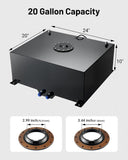
- 20 Gallon Fuel Tank: 24.02 × 19.88 × 10.04 in
For a simple rectangular tank, dividing the internal length × width × height in cubic inches by 231 gives an approximate U.S. gallon capacity.
Exterior measurements alone will overestimate usable capacity because wall thickness, rounded corners, anti-slosh foam, the pickup position and required vapor space reduce the volume available for fuel. For the most accurate answer, use the manufacturer’s rated capacity rather than calculating from exterior dimensions.
Q: What are the different types of fuel tank shapes?
A: Common fuel tank shapes include cube-style, rectangular, low-profile, cylindrical, wedge-shaped, saddle and vehicle-specific molded tanks.
- Cube-style fuel tanks concentrate capacity within a relatively compact footprint.
- Rectangular and low-profile fuel tanks fit wide, shallow spaces such as trunks, cargo floors and truck beds.
- Cylindrical fuel tanks are common where a round body is easier to support.
- Wedge-shaped fuel cells can follow a sloped floor or improve clearance around suspension and exhaust components.
- Saddle and molded fuel tanks are designed around a particular chassis.
The Evil Energy fuel tank on this page uses cube-style aluminum bodies. Although they belong to the same product family, their proportions vary by capacity, so buyers should compare the complete dimensions—not capacity alone—with the available mounting space.
Q: What are the main differences between Evil Energy rectangular and square fuel tanks?
Fuel Tank Capacity: The Evil Energy universal cube fuel tank comes in 8 fuel tank size options: 1 gallon fuel tank, 2.5 gallon fuel tank, 5 gallon fuel tank, 8 gallon fuel tank, 10 gallon fuel tank, 12 gallon fuel tank, 15 gallon fuel tank and 20 gallon fuel tank. The rectangular aluminum fuel tank is only available in 15 gallon fuel tank and 19 gallon fuel tank capacities and features a much lower‑profile footprint.
Sending unit: Most cube and rectangular tanks ship with a sending unit to monitor remaining fuel levels. Only the 1‑gallon cube tank does not include a sending unit.
Fuel Tank foam: Anti‑slosh foam is pre‑installed inside universal cube tanks from 1 gallon fuel tank up to 20‑gallon fuel cell. No anti‑slosh foam is fitted to the Evil Energy 15/19‑gallon rectangular aluminum tanks.
Inlet/Outlet/Vent Port: Port configurations vary between models. Universal cube tanks (2.5‑gallon through 20‑gallon) are built with four AN10 ports, consisting of two vent ports, one inlet port and one outlet port. The 15‑gallon and 19‑gallon rectangular aluminum tanks have three AN8 ports, arranged for one inlet, one outlet and one vent.
Fuel Tank Cap: There are also differences in fuel tank cap material and construction. All universal cube tanks use a quick‑disconnect plastic cap. Lift the tab, twist to unlock, then lift off the cap. The 15‑gallon and 19‑gallon rectangular aluminum tanks are fully aluminum units with screw‑on aluminum caps. These deliver superior sealing performance, better resistance to fuel‑related aging and increased durability.
Q: What is the difference between a fuel tank and a transfer tank?
A: A car fuel tank stores fuel and directly supplies the engine or other equipment mounted on that vehicle. An automotive fuel cell is a performance-oriented version commonly used in racing, engine swaps, off-road vehicles and custom builds.
A transfer tank is primarily designed to transport fuel and dispense it into another vehicle, generator or machine, often through a separate pump and nozzle. It should not automatically be connected as an engine-supply or auxiliary tank unless the tank and installation are specifically approved for that purpose. The applicable transportation requirements can change according to the fuel, capacity, construction, mounting and intended use. A vehicle‑mounted fuel tank serves to supply the host vehicle or connected equipment. Buyers should verify all federal, state and local requirements before transporting or dispensing fuel from a transfer tank.
Q: From 1 gallon to 20 gallons, how do you choose the right fuel cell capacity for drag, drift and street applications?
A: Start with actual fuel consumption rather than vehicle size alone:
Required capacity = fuel consumption per hour × operating time + reserve
Add a practical reserve for warm-up, staging, repeated runs, return-line circulation and fuel that may become unusable during acceleration or cornering. Then choose the next larger available capacity.
1–2.5 gallons are best suited to compact auxiliary systems, test setups or specialized short-duration race vehicles with a verified low fuel requirement. The 1-gallon Evil Energy tank does not include a fuel level sender.
A 5-gallon fuel cell is a common starting point for short drag sessions, lightweight race vehicles or builds where minimum weight and packaging are priorities. Confirm that it covers warm-up, staging, passes and return-to-pit operation without running the pickup near empty.
An 8–10-gallon fuel cell offers more reserve for drift sessions, autocross, track use and limited street-strip driving. Drift cars should carry enough usable fuel to prevent pickup exposure during sustained lateral movement.
A 12–15-gallon fuel cell generally provides a practical balance for multi-session drift cars, street-strip builds, LS swaps and performance vehicles that need usable driving range without the footprint of a 20-gallon tank.
A 20-gallon fuel cell is better for longer street driving, endurance use, off-road trips and high-consumption engines. For street-range planning, multiply usable gallons by the vehicle’s real-world MPG and subtract a reserve. For example, 15 gallons at 15 MPG gives a theoretical 225-mile range, but the planned range should be lower.
Always confirm mounting space, total filled weight, racing-class rules and fuel-system compatibility. One U.S. gallon of gasoline weighs approximately 6 lb, so increasing from 5 to 20 gallons can add roughly 90 lb of fuel.
Q: How do you know when your fuel tank is full?
A: On the Evil Energy 2.5–20-gallon fuel tanks, a properly matched gauge should approach “F” as the sender approaches 90 Ω. However, the gauge is an estimate and should not be the only indication used while refueling.
Park on level ground, turn off the engine and all ignition sources, then add fuel slowly while monitoring the amount dispensed. Stop when the tank reaches its rated usable capacity or the filling system indicates full. Do not fill liquid fuel to the cap or continue adding fuel after the tank is full; fuel requires expansion and vapor space, especially as temperature rises. NHTSA’s definition of fuel-tank capacity excludes the vapor space above the usable fuel volume.
After the first fill, inspect the cap, sender flange, AN connections, vent line and tank seams for leakage. A correctly routed, unobstructed vent is necessary for both refueling and normal fuel delivery.
Q: How do you connect, test, and read the fuel tank gauge?
A: The Evil Energy Cube Style 2.5/5/8/10/12/15/20 gallon fuel tanks use a 3–90 Ω sender. Before installing, confirm your gauge is designed for the same range (0 Ω = empty, 90 Ω = full) — this is common on some GM-style gauges but not universal, and a mismatch will cause incorrect readings.
Connecting the sender: Wire the signal lead to the gauge's input and the ground lead to a solid ground point on the tank or chassis. Make sure the AN fittings and sender flange are properly sealed before wiring to avoid future leaks — poor grounding is a common cause of erratic or inaccurate readings.
Testing before installation: Before permanently mounting the tank, manually sweep the sender float from empty to full while measuring resistance with a multimeter. Confirm a smooth 0–90 Ω sweep with no jumps, sticking points, or open circuits. This catches float binding or bad internal contacts early.
Reading the gauge: 0 Ω represents empty, roughly 45 Ω represents the middle of the sender's electrical range, and 90 Ω represents full. Because float travel and tank shape aren't always perfectly linear, the midpoint reading may not equal exactly half the fuel volume — this is normal, not a fault.
Troubleshooting: If the gauge reads backward, stays on empty, or jumps unpredictably, check in order: the gauge's resistance range vs. the sender, the sender's ground connection, the signal wire for looseness or corrosion, and whether the float moves freely without binding.
Q: What Is a Fuel Tank Sending Unit Made Of?
A: Float: The float rests on the fuel surface and moves up or down as the fuel level changes.
Float Arm: The arm connects the float to the sender and transfers the float’s movement to the internal resistance mechanism.
Variable Resistor: The resistor converts the float position into a 3–90Ω signal that can be interpreted by a compatible Fuel Gauge.
Mounting Flange: The flange secures the Sending Unit to the top of the fuel tank and keeps the float assembly in the correct position.
Gasket: The gasket seals the area between the mounting flange and the tank to help prevent fuel from leaking around the sender opening.
Signal and Ground Wires: The green wire carries the sender signal to the Fuel Gauge, while the yellow wire provides the ground connection.
Q: How Does the EVIL ENERGY Fuel Tank Sending Unit Work?
A: The operating process is simple: the fuel level changes, the float rises or falls, the float arm moves the variable resistor, and the resistance changes within the 3–90Ω range. The Fuel Gauge reads that signal and converts it into an easy-to-read fuel-level display inside the vehicle.
For the most accurate reading, check the gauge while the vehicle is parked on a level surface and allow the fuel to settle after driving.
Q: How long does foam last in a fuel cell?
A: Fuel Cell Foam does not have one fixed service life. Longevity depends on the foam material, fuel type, operating temperature, storage conditions, and frequency of use. Inspect it during routine fuel-system service and replace it if it begins to shrink, soften, harden, separate, or crumble. Foam particles in the Fuel Filter, unusual pump noise, unstable fuel pressure, or reduced fuel flow may also indicate deterioration.
Before using E85, ethanol, methanol, or specialty racing fuel, confirm that the foam is chemically compatible with that fuel. If deterioration is found, replace the foam, clean the tank and fuel lines, and inspect the filter and pump inlet before returning the vehicle to service.
Q: What is included with a tank-only purchase, and what else do I need for a complete fuel system?
A: An Evil Energy cube tank-only purchase includes the aluminum fuel cell, quick-release cap and internal anti-slosh foam. The 2.5–20-gallon versions also include an integrated 0–90 Ω fuel level sender; the 1-gallon version does not.
A complete operating fuel system normally also requires a fuel pump matched to the engine’s required flow and pressure, compatible pre-pump and post-pump filters, a fuel pressure regulator, supply and return hoses, AN fittings and adapters, a properly routed vent hose with suitable rollover protection, a compatible fuel gauge, electrical wiring with relay and fuse protection, and secure mounting support or straps. A remote filler neck may also be needed depending on the installation.
Every hose, Evil Energy 300LPH in line fuel pump and fuel filter must be compatible with the selected fuel. Buyers who do not already have these components can choose an Evil Energy complete fuel cell tank kit instead of assembling the system part by part.
Q: How Do You Maintain Fuel Cell Foam?
A: Fuel Cell Foam is not a permanent, maintenance-free component. Its service life depends on fuel type, operating temperature, storage conditions, and how often the vehicle is used. Because these conditions vary from one build to another, a single replacement interval should not be applied to every fuel cell.
Inspect the foam during routine fuel-system service. Look for shrinking, distortion, separation from the tank walls, softening, hardening, brittleness, or crumbling. Foam particles in the fuel filter, unusual fuel-pump noise, unstable fuel pressure, or reduced flow may also indicate that the foam is beginning to break down. Recheck compatibility whenever changing to a different fuel.
If the foam begins to deteriorate or shed particles, stop using the system until it has been serviced. Replace the foam, clean the tank and fuel lines, inspect or replace the fuel filter, and check the fuel-pump inlet for debris. Before refilling the tank, inspect the complete system for leaks and verify proper fuel flow.
Q: How do I open the quick-release plastic cap on the Evil Energy auxiliary cube fuel tank?
A: The quick-release cap opens in two simple steps—no tools required.
Step 1: Lift the lever to unlock the cap
Grip the lever on top of the cap and pull it firmly upward until it stands upright. This releases the internal locking tabs so the cap can turn.
If the lever is still flat, the cap is still locked. Do not force the cap, as this may damage the locking tabs.
Step 2: Turn and remove the cap
Keep the lever upright, then turn the cap counterclockwise in the direction of the arrow. Once loosened, lift the cap off the fuel tank.
Important safety notes:
- A new cap, or one that has not been opened for a long time, may feel tight because of the seal. Apply a light coating of fuel-compatible grease to the threads or sealing ring if needed.
- If the tank has been sitting in direct sunlight or exposed to high temperatures, loosen the cap slowly and allow any pressure to vent before removing it completely.
- Fuel and fuel vapors are highly flammable. Shut off the engine, allow it to cool, and keep flames, sparks, cigarettes, and static discharge away from the tank.
- After reinstalling the cap, press the lever completely flat to lock it. A raised lever means the cap is not fully secured. Always check it before driving.
Q: How Can You Spot a Quality Weld of Universal Fuel Tank?
A: Check these three details:
- Consistent Beads: The weld should be smooth, even, and continuous, with no visible gaps, pinholes, heavy spatter, or abrupt stops.
- Factory Leak Testing: Confirm that the tank has gone through a documented leak or pressure test before leaving the factory. Do not pressure-test a fuel tank yourself without an approved procedure and proper equipment.
- Verified Material and Thickness: Look for clearly stated aluminum grade, wall thickness, and welding method—not simply an “aluminum tank” claim.
A quality weld should not demand constant attention. A poor weld will eventually make itself known.
Q: How does this Evil Energy aluminum fuel cell compare to RCI, JAZ and Summit Racing fuel cells?
A: The best choice depends more on the exact model than the brand name. Evil Energy aftermarket fuel tank focuses on broad capacity coverage and includes components: eight sizes from 1–20 gallons, a 1060‑H24 aluminum body, 2.5 mm wall thickness, anti-slosh foam in every listed size and a 3–90 Ω sender in all sizes except 1 gallon. It is particularly convenient for builders who want a cube-style aluminum tank with multiple capacity choices.
RCI fuel tank offers numerous aluminum racing-cell configurations, with sender, foam, outlet and cap arrangements varying by part number. Its installation guidance emphasizes full structural support, mounting straps, grounding and dedicated venting, so buyers should compare a specific RCI part number rather than assume every RCI cell has the same equipment.
JAZ fuel tank is especially strong in seamless cross-linked polyethylene and polyethylene-in-steel-container designs. Depending on the series, JAZ offers cells with or without foam and has specifically labeled SFI-certified options for racing classes that require certification. This makes JAZ worth considering when a polyethylene construction or rulebook-specific certification is the priority.
Summit Racing offers a wide catalog that includes its own aluminum fuel cells and products from other manufacturers. For example, its 20-gallon aluminum house-brand model uses 0.100-inch aluminum and a 0–90 Ω sender, while other Summit-listed models may be pump-ready or use different foam, outlet and sender configurations.
Before choosing, compare capacity, exterior dimensions, construction material, foam, sender range, outlet and vent sizes, cap type, mounting method, fuel compatibility and any racing certification required by the sanctioning body.


![[Black]EVIL ENERGY Fuel Cell Gas Tank with Level Sender Black Street Drift Aluminum](http://www.ievilenergy.com/cdn/shop/files/EVIL-ENERGY-Fuel-Cell-Gas-Tank-Kits-with-Fuel-Filter-Fuel-Pump_1-2.5-5-8-10-12-15-19-20-Gallon-_-_Copy_-EVIL-ENERGY-150381135.jpg?v=1781887917)
![[Silver]](http://www.ievilenergy.com/cdn/shop/files/fuel_cell_silver.jpg?v=1785396278)
![[Black]](http://www.ievilenergy.com/cdn/shop/files/AN8.png?v=1787822236)
![[Silver]](http://www.ievilenergy.com/cdn/shop/files/AN8_df8a39dd-36f6-47e7-9801-be46572a1230.png?v=1787822454)

![[Silver]](http://www.ievilenergy.com/cdn/shop/files/d329ab0679e2f250204657f2c5f94bb0.jpg?v=1787822454)
![[Black]](http://www.ievilenergy.com/cdn/shop/files/c2055e4ed4888a2192675e2a675adddb.jpg?v=1787822236)
![[Silver]](http://www.ievilenergy.com/cdn/shop/files/9608c6f1e21eb58c40d67de5909cafba.jpg?v=1787822453)
![[Black]](http://www.ievilenergy.com/cdn/shop/files/image_7_15e0962b-2b9c-405c-b7fe-6a70bece9fe0.jpg?v=1787822553)

![[1 Gallon,Silver]](http://www.ievilenergy.com/cdn/shop/files/image_1_622118af-273f-4c5c-a81b-4bc126672f10.jpg?v=1787823218)
![[1 Gallon,Black]](http://www.ievilenergy.com/cdn/shop/files/image_1_9685d815-098d-425c-8dc0-62d5b136119e.jpg?v=1787823072)
![[1 Gallon,Silver]](http://www.ievilenergy.com/cdn/shop/files/image_2_5a21011b-bb46-4f25-9501-fc536bf699f6.jpg?v=1787823218)
![[1 Gallon,Black]](http://www.ievilenergy.com/cdn/shop/files/image_2_c0e4fc2d-6d69-4c69-8f51-dccaa40257f2.jpg?v=1787823072)
![EVIL ENERGY 5 Gallon Fuel Cell Gas Tank - Aluminum Fuel Cell with Capacity Shown [5 Gallon]](http://www.ievilenergy.com/cdn/shop/files/5_Gal_fuel_cell_tank_size.jpg?v=1757384948)
![EVIL ENERGY 8 Gallon Fuel Cell Gas Tank - Aluminum Fuel Cell with Capacity Shown [8 Gallon]](http://www.ievilenergy.com/cdn/shop/files/8_Gal_fuel_cell_tank_size.jpg?v=1773903054)
![EVIL ENERGY 10 Gallon Fuel Cell Gas Tank - Aluminum Fuel Cell with Capacity Shown [10 Gallon]](http://www.ievilenergy.com/cdn/shop/files/10_Gal_fuel_cell_tank_size.jpg?v=1757384948)
![EVIL ENERGY 12 Gallon Fuel Cell Gas Tank - Aluminum Fuel Cell with Capacity Shown [12 Gallon]](http://www.ievilenergy.com/cdn/shop/files/12_Gal_fuel_cell_tank_size.jpg?v=1757384948)
![EVIL ENERGY 20 Gallon Fuel Cell Gas Tank - Aluminum Fuel Cell with Capacity Shown [20 Gallon]](http://www.ievilenergy.com/cdn/shop/files/20_Gal_fuel_cell_tank_size.jpg?v=1773903054)
![EVIL ENERGY 15 Gallon Fuel Cell Gas Tank - Aluminum Fuel Cell with Capacity Shown [15 Gallon]](http://www.ievilenergy.com/cdn/shop/files/15_Gal_fuel_cell_tank_size.jpg?v=1757384948)




![[1 Gallon,Silver]](http://www.ievilenergy.com/cdn/shop/files/image_1_622118af-273f-4c5c-a81b-4bc126672f10_1200x.jpg?v=1787823218)


 Note:The yellow wire is the ground wire, and the green wire is the connector wire.


