Carburetor

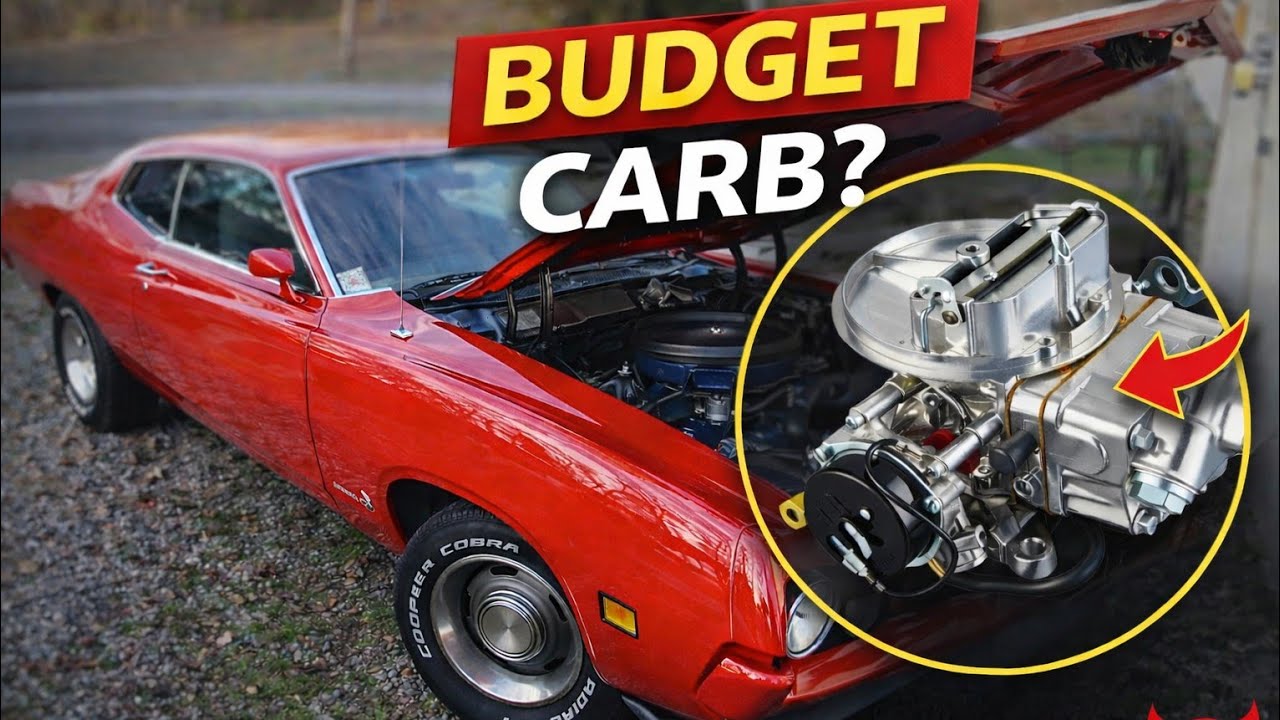
EVIL ENERGY offers a comprehensive lineup of performance carburetors for car enthusiasts, professional tuners, and restoration builders. From compact 2-barrel carburetors designed for small block applications to high-flow 4-barrel carburetors pushing up to 850 CFM, our collection is engineered to meet a wide range of power demands and vehicle setups. Whether you're tuning a vintage muscle car or upgrading your daily driver, we deliver some of the best carburetors available online.

Street Carburetors vs. Performance Carburetors vs. Marine Carburetors

Feature Street Carburetors Performance Carburetors Marine Carburetors
Primary Use Daily driving, commuting Racing, high-performance builds Boats, marine applications
Key Characteristics Smooth acceleration, fuel efficiency Maximum horsepower, tunable Corrosion-resistant, vibration-proof
Throttle Design 2-barrel or 4-barrel 4-barrel (dominant) 4-barrel (marine-specific)
Secondary Type Vacuum secondaries Mechanical/Adjustable Air Valve Marine-optimized secondaries
Fuel Delivery Balanced for street use High-flow (#90+ jets) Stable in rough conditions
Choke Options Electric or manual Manual only Marine-specific choke
RPM Range Ideal for low-mid range Optimized for high RPM (8000+) Consistent under load
Compatibility GM, Chrysler, Ford A/T linkage Race applications Marine engines only
Best For 18% more torque for street use Drag strips, forced induction Saltwater/wet environments
Recommended Models 350 CFM 2-Barrel Carburetor
500 CFM 2-Barrel Carburetor
650 CFM 4-Barrel Carburetor
750 CFM 4-Barrel Carburetor
600 CFM Marine Carburetor

Why Upgrade Your Carburetor?

1. Old or Faulty Carburetor

  • Common issues: Stuck floats, clogged jets, fuel delivery problems
  • Effects: Hard starting, rough idle, poor acceleration
  • Risk: Leaks from worn gaskets & seals

2. More Power & Throttle Response

  • Stock carbs are fuel-efficient but restrictive
  • Upgrade to: Larger CFM (e.g., 750 CFM 4-barrel Carburetor) for better airflow & performance

3. Engine Mods Demand More Fuel

  • Needed if you have: High-flow intake, aggressive cam, open exhaust, or bigger bore
  • Solution: Higher CFM carb to match increased air intake

4. Easier Tuning for DIY Users

  • Simple adjustments: Idle screws, jets, float height (no ECU needed)
  • Best for: Vintage cars, track builds, or hands-on enthusiasts

5. Better for Special Conditions

  • Preferred in: Racing, off-road, tractors
  • Advantages: No electronics, reliable in cold/altitude/extreme environments

Upgrade Tip: Match your carb (CFM size...) to your engine’s needs!

Why Choose EVIL ENERGY Carburetors?

Performance Without Compromise, Price Cut in Half

  • Matches the performance of leading models like Holley 4150/4160 & Edelbrock 1404
  • More value for less - Same performance at 30-50% of premium brand prices

Perfect Fit, Hassle-Free Installation

  • Maintains OEM mounting points and connection specs for true plug-and-play
  • Complete installation kit included for effortless setup

Smart Pre-Tuning, Ready to Run

  • Factory-preset Street/Off-road/Classic driving modes
  • Optimized fuel curves for different road conditions
  • Professional tuning ports remain accessible for advanced customization

Timeless Design, Where Heritage Meets Performance

  • Available in chrome, matte black & oxidized aluminum finishes
  • Faithfully recreates 70s-80s classic styling
  • Ideal for muscle car and classic vehicle restoration projects
EVIL ENERGY Carburetors - Professional-grade performance at honest prices.


+ Read more

Choose a Carburetor by Engine and Use - Not CFM Alone

Start with engine displacement, expected maximum RPM, volumetric efficiency, and street or performance use. Then choose the barrel configuration, secondary type, choke, and supporting fuel-pressure system. A larger CFM number alone does not confirm better drivability, direct fitment, or power support.

Check before choosing:

  • Confirm the required 2-barrel or 4-barrel configuration and flange or bolt pattern.
  • Choose manual, electric, or no choke based on cold-start control, wiring, and driver preference.
  • Confirm the secondary type and the throttle response required for the build.
  • Verify inlet pressure, regulator and filter requirements, linkage, clearance, and tuning needs.

Use the selector and the exact product page to verify current SKU facts. Do not assume that “universal” means direct vehicle fitment or that every carburetor includes the same calibration, linkage, or installation hardware.

Carburetor Selector

ENGINE:

Your engine's cubic inches

Your expected maximum RPM (Redline)

WHAT TYPE OF CARBURETOR ARE YOU LOOKING FOR?

SECONDARIES:

CHOKE:


If you have any other questions, please contact Customer Service at support@ievilenergy.com for assistance.

Carburetor Guide: Are You Choosing Right?

Why Choose EVIL ENERGY Carburetors?

FAQs about Carburetor

What is a Carburetor in a Car?

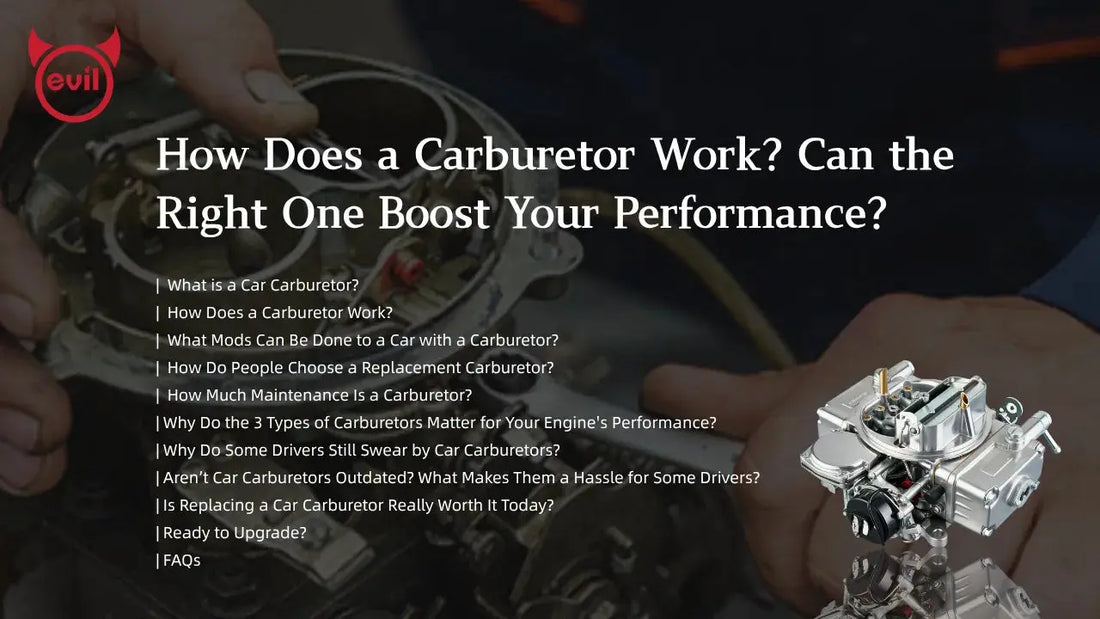
A carburetor is a mechanical device in older internal combustion engines that mixes air and fuel in the correct ratio for combustion. Located between the air filter and the intake manifold, it uses engine vacuum and fuel jets to atomize fuel and deliver it to the cylinders.

The primary function of a carburetor is to:

  • Mix air and gasoline in the ideal ratio (usually around 14.7:1 for gasoline engines)
  • Control engine speed and throttle response
  • Provide extra fuel when accelerating (via an accelerator pump)
  • Maintain stable idle and efficient fuel delivery at all RPM ranges

It essentially manages how much fuel your engine gets at any given moment, depending on throttle position and engine load.

Choosing the best carburetor depends on your engine type, driving style, and performance goals. Consider the following factors:

  1. Engine Displacement
  2. CFM Rating (Cubic Feet per Minute)
  3. Barrel Type
  4. Choke Type
  5. Application Type
  6. Brand and Compatibility

For example, if you own a small-block V8 and want a balance of performance and driveability, a 600 CFM square-bore carburetor with vacuum secondaries would be ideal.

No, most modern vehicles do not have carburetors. Since the late 1980s to early 2000s, automakers transitioned to electronic fuel injection (EFI) systems, which are more efficient and environmentally friendly. Today, carburetors are mainly found in:

  • Classic cars
  • Some off-road or motorsport vehicles
  • Small engines (like motorcycles, lawn mowers)

No, a car with a carbureted engine cannot run without a carburetor, as it would have no way to mix and deliver fuel to the engine. However, carbureted cars can be converted to EFI, which replaces the carburetor with a fuel injection system. EFI systems are more efficient, especially in cold starts and altitude changes.

.

RECENTLY VIEWED PRODUCTS