


In 2026, fuel pump replacement typically costs between $400 and $1,500+, including parts and labor. A basic aftermarket pump replacement at an independent repair shop may fall near the lower end, while OEM in-tank pump modules, trucks, luxury vehicles, and dealership repairs can cost much more.
The final price depends on your vehicle, pump type, fuel tank access, labor rate, location, and whether related parts such as the fuel filter, seals, relay, wiring, or fuel lines also need service. This guide breaks down the real cost of fuel pump replacement, explains why estimates vary, and helps you decide whether a standard replacement or a performance fuel pump upgrade makes more sense for your vehicle.

A failing fuel pump rarely gives much warning—many drivers first realize something is wrong when the car stalls or refuses to start. That is exactly why the repair cost is worth understanding before it happens to you.
How Much Does Fuel Pump Replacement Cost in 2026?
When faced with a failing fuel pump, one of the first questions that comes to mind is, “How much will it cost to replace it?” On average, the total cost for a fuel pump replacement in 2026 falls between $400 and $1,500, including both the parts and the labor required for installation. Complex jobs—diesel trucks, hard-to-access tanks, or luxury vehicles needing OEM modules—can push the total above $1,500.
Repair costs include parts, labor, and often additional services such as fuel system diagnostics, tank draining, or a fuel system flush. Two vehicles that use similar pumps can still receive very different quotes, because access design and local labor rates matter as much as the pump price itself.
Here is how the money typically breaks down. OEM fuel pumps generally range from $200 to $1,000, while aftermarket pumps can be found for as little as $20 and up to $400. Labor usually runs $250–$600 for most vehicles and can climb to $800 or more when the fuel tank must be lowered or removed. Most shops charge hourly rates of $50–$150, so a job that takes several hours adds up quickly. Many invoices also include diagnosis time, a new filter, seals, or shop supplies.

Parts, labor, and diagnosis fees all show up on the invoice. A quote that lists them separately makes it much easier to judge whether the price is fair.
What Is a Fuel Pump and What Does It Do?
A fuel pump is an essential part of your car’s fuel system. Its main job is to pull fuel from the tank and push it toward the engine with the correct pressure. Whether you drive a daily commuter or a high-performance build, the pump ensures your engine gets the right amount of fuel when it needs it.

An electric fuel pump like this one keeps fuel flowing at steady pressure. When it weakens, every downstream component—injectors, spark plugs, even the catalytic converter—can be affected.
Without a functioning fuel pump:
- Your engine may crank but not start.
- Acceleration will suffer, especially under load or going uphill.
- You could end up stranded.
In normal operation, the pump keeps fuel flowing under the right pressure, supports consistent performance, and helps with cold starts and throttle response.
What Are the 3 Main Types of Fuel Pumps?
Not all fuel pumps are the same, and the type in your vehicle has a direct impact on the replacement bill:
- Mechanical fuel pumps – Typically found in older carbureted engines. They are mounted on the engine and operated by a lever that rides on a camshaft lobe. Reliable for low-pressure systems, but outdated for modern setups.
- Electric in-tank fuel pumps – The most common type in today’s cars. Installed inside the fuel tank, they push fuel to the engine at high pressure. They work well but are harder to access, which is why they are more costly to replace.
- Electric inline fuel pumps – Mounted outside the tank, often along the frame rail or near the engine. They are easy to access and are the go-to choice for performance builds, LS swaps, and retrofits.
Cost impact: replacing an in-tank pump can add 30–50% more labor compared with an external inline pump, simply because the tank must be drained, supported, unbolted, and lowered first.
High-Pressure Fuel Pump (GDI) Replacement Cost
Many newer gasoline engines use gasoline direct injection (GDI), and these engines have two pumps. A low-pressure electric pump in the tank sends fuel forward, and a mechanical high-pressure fuel pump mounted on the engine and driven by the camshaft raises that pressure to 2,000 psi or more so fuel can be injected directly into each cylinder.
A high-pressure pump replacement usually costs more than replacing the in-tank pump for several reasons:
- Precision part: High-pressure pumps are precision-machined and are often available only as OEM or OE-equivalent units.
- Extra parts: The job may also call for a new high-pressure line, seals, and, on some engines, the cam follower that drives the pump.
- Access: Some engines require removing intake components or engine covers to reach the pump.
- Verification: After installation, the shop should check rail pressure with a scan tool to confirm the repair.
Before approving a high-pressure pump quote, confirm which pump actually failed. Long cranking and power loss can come from either the in-tank lift pump or the high-pressure pump, and the in-tank pump is often the less expensive fix. A scan tool reading of low-side and rail pressure settles the question.
Key Factors Affecting Fuel Pump Replacement Cost
1. Vehicle Make and Model
Luxury vehicles cost roughly 30–50% more to service because of OEM parts pricing and labor complexity, while compact cars are easier to work on and use cheaper aftermarket parts. The table below shows typical full-replacement ranges by vehicle type:
| Vehicle Type | Typical Total Cost | Why It Costs More or Less |
|---|---|---|
| Compact cars and sedans | $450–$850 | Smaller tanks, common parts, and simpler layouts keep labor down |
| SUVs and crossovers | $650–$1,150 | Many need a complete pump module instead of only the pump |
| Pickup trucks and full-size SUVs | $750–$1,350 | Larger tanks, heavier components, and longer access time |
| Luxury vehicles | +30–50% vs. comparable non-luxury models | OEM modules, specialized diagnostics, and higher labor rates |
| Diesel trucks | $1,000–$2,000+ | Higher parts cost, contamination checks, and more diagnosis time |
| Performance builds and custom fuel systems | $600–$1,450 | May require pump, regulator, filters, fuel lines, fittings, wiring, and mounting work |
2. Vehicle Accessibility
Labor cost depends heavily on how easily the mechanic can reach the pump. Some vehicles have an access panel under the rear seat or trunk area, which can cut labor time dramatically. Others require the fuel tank to be drained, supported, unbolted, and lowered before the pump can be replaced. This is why two vehicles using similar pumps can still have very different estimates.
3. Regional Labor Rates
Where you live changes the hourly rate more than almost anything else. Urban shops in major metros often charge $120–$150 per hour, while rural shops in lower-cost states may charge $50–$70 per hour for the same job. Urban shops generally run 20–40% higher than rural ones.
4. Additional Parts
In some cases, replacing the pump also requires replacing related components such as fuel lines, fuel filters, or gaskets. These additional parts add to the overall cost but protect the new pump from early failure.
5. Vehicle Age and Condition
Older, high-mileage vehicles may need additional repairs to related components—rusted tank straps, corroded wiring, or degraded seals—which increases the final bill.
6. Dealership vs. Independent Shop
Dealerships usually charge more for labor than independent repair shops, often for the same OEM part. For a straightforward pump swap on a common vehicle, an independent shop is usually the better value.
7. Warranty Coverage
If the vehicle is still under warranty, the fuel pump replacement may be covered, reducing or eliminating out-of-pocket costs. Always check before paying for the repair yourself.
Cost Factors at a Glance
| Factor | Impact on Cost |
|---|---|
| Vehicle type | Luxury cars cost 30–50% more |
| Fuel pump design | In-tank pumps increase labor cost by 30–50% |
| Fuel system type | GDI high-pressure pumps usually cost more than in-tank lift pumps |
| OEM vs. aftermarket parts | OEM: $200–$1,000; Aftermarket: $20–$400 |
| Region | Urban shops charge 20–40% more than rural shops |
| Repair type | DIY: $50–$200; Professional: $400–$1,500 |
Fuel Pump Replacement Cost Calculator
Fuel pump replacement cost can change a lot depending on the vehicle, pump design, labor rate, and whether the fuel tank must be removed. Use the calculator below to get a quick estimate before you compare a shop quote, choose a replacement pump, or decide whether DIY repair makes sense.
Estimate Your Repair Cost
Pick Your Repair Scenario
Choose the repair scenario that best matches your vehicle. This quick estimator helps you compare typical fuel pump replacement costs before approving a shop quote or deciding whether DIY repair makes sense.
Note: Totals include parts, labor, and typical diagnosis, filter, seal, or shop-supply charges. These estimates are for quick decision-making only. Actual fuel pump replacement cost varies by vehicle, region, labor rate, pump design, diagnosis time, fuel tank access, and related parts.
Real-World Fuel Pump Repair Examples
Numbers on a page only tell part of the story. Here are two real repairs that show how the same problem can cost very different amounts depending on the vehicle and where you take it.
Case 1: Toyota Camry — $350 at an independent shop
- Issue: Stalling and a Check Engine light
- Fix: Replaced the in-tank pump through the rear-seat access panel and flushed the fuel system
- Cost: $350
- Outcome: Smooth driving and better mileage
This repair came in below the typical $400–$1,500 range because the pump could be reached through an access panel under the rear seat—no tank drop required, so labor stayed low.
Case 2: BMW 3 Series — $700 at a dealership
- Issue: Whining noise from the tank
- Fix: OEM pump replaced at the dealership
- Cost: $700
- Outcome: Problem solved, but costlier than a DIY or independent-shop repair
An OEM pump plus dealership labor lands in the lower-middle of the typical range—more than an independent shop would charge, but far from the worst case.
Can a Fuel Pump Be Repaired, or Does It Need Replacement?
In most modern vehicles, a failed fuel pump is replaced rather than repaired internally. When people search for fuel pump repair cost, they are often talking about the total cost to diagnose and fix a fuel delivery problem—which may include the pump, relay, wiring, fuel filter, seals, or connectors.
Minor fixes cost $50–$200. If the issue is caused by a clogged filter, damaged wiring, bad relay, or poor connection, the pump itself may not need to be replaced—cleaning connections, swapping a relay, or changing a filter solves it. But if the pump motor has failed, replacement is the only real fix, and that is when the $400–$1,500 range applies. A DIY external pump swap on an older vehicle can total just $50–$200 in parts and tools, while professional replacement typically runs $400–$1,500 but includes warranty, expertise, and safety. That is why proper diagnosis matters before buying parts.
Signs of a Bad Fuel Pump You Shouldn't Ignore
Cost matters, but symptoms matter too. When my own fuel pump started going out, the symptoms came on gradually—but they were all there. A weak pump causes drivability problems long before it fails completely, so if you notice any of the following signs, have the fuel system inspected before replacing parts blindly:
- Engine sputtering: Hesitation or jerking at speed, especially at highway speeds, can point to inconsistent fuel delivery.
- Hard starting / long cranking: Long cranking or multiple start attempts may indicate low fuel pressure.
- Power loss under load: A weak pump may not supply enough fuel during acceleration, towing, climbing, or high-RPM driving.
- Whining from the fuel tank: A loud buzz or whine can mean the pump is struggling or overheating.
- Stalling: Random stalling can happen when fuel pressure drops unexpectedly—even with a full tank.
- Poor fuel economy or misfires: Fuel delivery problems contribute to inefficient engine operation, though other causes should also be checked.

Six symptoms that almost always point to a weak or failing fuel pump. If two or more of these appear together, test fuel pressure before spending money on other parts.
It is easy to blame bad gas or old spark plugs for these issues, but in many cases the real problem is fuel delivery.
What Happens If You Ignore a Bad Fuel Pump?
Hoping the problem goes away only makes things worse. Keep driving on a failing pump and you risk:
- Sudden engine shutdown while driving, which can be dangerous
- Reduced fuel pressure, leading to poor acceleration and hesitation
- Hard starts or complete no-start conditions
- Overworked fuel injectors, possibly leading to more costly repairs
- Lean air-fuel mixture, which can damage your engine over time
How to Start a Car If the Fuel Pump Is Bad
If the pump has completely failed, the car may not start at all until it is replaced. But if the pump is weak or only intermittently working, a few simple checks can get the engine running long enough to reach a shop:
- Check the fuse and relay first: A blown fuse or faulty relay can mimic pump failure. Swapping in a matching relay or testing the fuse is a quick, free check.
- Key cycling trick: Turn the key to the “ON” position (not start) for 2–3 seconds, then back off. Repeat 3–5 times before starting. This helps build fuel pressure in weak systems.
- Tap the fuel tank: If the pump motor is stuck, a firm tap on the bottom of the tank (with a rubber mallet or your palm) can sometimes jolt it into action temporarily.
These tricks might work once or twice—they are not long-term solutions. The real fix is replacing the pump.
How to Install a New Inline Fuel Pump
If you are replacing an external inline pump yourself—whether on a daily driver, an LS swap, or a retrofit—correct plumbing and wiring matter as much as the pump itself. When I swapped in a 300LPH external inline pump on my project car, the installation followed the two-stage filtration layout below, and it made a noticeable difference: better throttle response, smoother idling, and cleaner pulls at higher RPMs.
- Choose a mounting location. Mount the pump close to the fuel tank, ideally below the fuel level, to ensure gravity-assisted fuel flow and prevent dry starts.
- Install the pre-filter (100 micron). Connect a fuel line from the tank outlet to a 100-micron filter to catch large debris before it reaches the pump.
- Connect the fuel pump. Route a line from the pre-filter to the pump inlet, then connect another line from the pump outlet to the next component.
- Install the post-filter (10 micron). Place a 10-micron filter after the pump to catch fine contaminants before fuel reaches the engine or pressure regulator.
- Connect the fuel pressure regulator. Route filtered fuel into the regulator, which controls pressure to the injectors. The regulator should also have a return line back to the tank.
- Wire the fuel pump. Connect the pump’s power lead to a relay triggered by the ignition switch, and include a fuse for protection. Ground the negative lead securely to the chassis.
- Prime and adjust the system. Turn the ignition to ON (engine off) to prime the system, then adjust the regulator to match your engine’s required fuel pressure.
- Check for leaks and secure fittings. Inspect all lines, clamps, and fittings to ensure there are no leaks and everything is securely mounted.

The correct plumbing order for an inline pump: tank → 100-micron pre-filter → pump → 10-micron post-filter → pressure regulator → engine. The two-stage filters are what keep the new pump alive for the long haul.

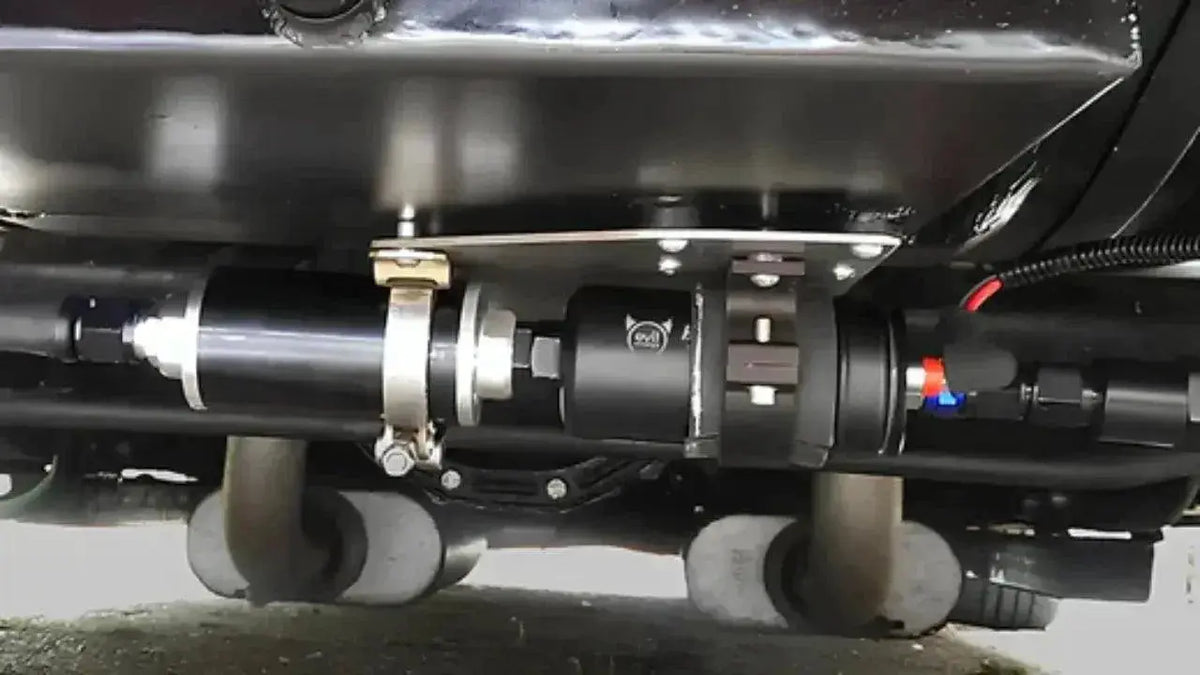
A mounted inline pump on a real build. Keeping the pump low and close to the tank, as shown here, helps it prime easily and run quietly.
How I Saved Money on My Project Car's Fuel System
My car is a project build with an external inline fuel setup, so instead of paying a shop to piece the system together, I went with a 12V universal fuel pump kit for its higher fuel pressure and convenient installation. These kits typically include the fittings you need, so buying the pump, lines, and fittings together cost far less than sourcing each part separately and paying shop labor.

LS Swap Fuel Line Kit PTFE Fuel Line 300 LPH Fuel Pump Universal
This universal fuel line kit includes high-quality PTFE hose and a 300 LPH fuel pump, designed for LS engine swaps to ensure reliable fuel delivery and performance.
- 300 LPH Pump
- PTFE Fuel Line
- Universal Fit
For more comprehensive needs, the EFI Fuel System Kit offers an all-in-one solution—bundling the fuel pump, PTFE fuel lines, and AN fittings. That not only simplifies installation but also cuts overall cost and sourcing time compared with buying each part separately.

EFI Fuel System Kit PTFE Fuel Line 300LPH Fuel Pump
This EFI fuel system kit includes durable PTFE fuel lines and a 300LPH fuel pump designed for efficient and reliable fuel delivery in electronic fuel injection setups.
- 300 LPH Pump
- PTFE Fuel Line
- AN Fittings
For LS swaps and other custom fuel system builds, complete fuel line kits stand out for their flexibility, clean layout, and ease of routing—ideal for both street and track projects.
Driving a stock daily driver? Universal performance kits are built for modified and custom fuel systems. For a stock vehicle, the right fix is usually a direct-fit replacement pump that matches the original fuel pressure, flow rate, wiring, and tank design.
Cost-Saving Tips for Fuel Pump Replacement
- DIY installation: If you have the skills and tools, installing the pump yourself can cut $250–$800 or more in labor from the total bill. Best suited to older vehicles with external pumps or easy access panels.
- Shop around: Compare quotes from different shops and suppliers, and ask for a quote that separates parts from labor.
- Preventive maintenance: Regular upkeep, like changing the fuel filter and cleaning the fuel system, delays the need for a replacement.
- Consider reputable aftermarket options: Quality aftermarket pumps cost a fraction of OEM modules—$20–$400 versus $200–$1,000—and reputable brands back them with real support.
Maintenance Tips to Extend Fuel Pump Life
- Replace fuel filters every 15,000–30,000 miles
- Use high-quality fuel to reduce system contamination
- Regularly inspect for fuel pressure issues or leaks
- Avoid frequently running the tank very low—the fuel cools the pump, and running low increases heat and wear
Recommended Replacement Fuel Pumps
When choosing a replacement fuel pump, quality and compatibility are what determine performance and longevity. Evil Energy offers a range of high-quality aftermarket fuel pumps designed to improve fuel delivery and engine reliability:
- Versatile applications: Compatible with gasoline, diesel, and E85, covering a wide range of vehicles and performance needs.
- Temperature resistant: Built to withstand extreme conditions from -68°F to 194°F, ensuring stable fuel flow in harsh environments.
- Consistent performance: Dependable pressure and flow rate for daily drivers, modified engines, or high-performance builds.
- Customer support: Responsive help throughout the purchase and installation process, so you avoid common pitfalls.

A quality aftermarket pump delivers the pressure and flow your engine needs at a fraction of OEM module pricing—especially valuable for older vehicles and performance builds.
If you are looking for a dependable, cost-effective replacement, the Evil Energy fuel pump collection is a trusted option for both DIYers and professionals.

Complete Your Fuel System
AN fittings, regulators, filters, and more—engineered for street cars, race builds, and LS swaps.
Shop Fuel System PartsFinal Thoughts
Replacing a fuel pump is a critical maintenance task that should not be ignored. While the costs can vary, neglecting a failing pump leads to more significant and expensive issues down the line—sudden shutdowns, damaged injectors, even engine damage from a lean mixture. By knowing the signs of a bad pump, the replacement steps, and the real costs, you can make a smart choice that keeps your vehicle running well for a long time.
Keep in mind that investing in good parts and skilled workers saves money over time. For a stock daily driver, the best choice is usually an OEM-style or direct-fit replacement pump that matches the vehicle’s original fuel pressure, flow rate, wiring, and tank design.
For modified vehicles, the decision is different. LS swaps, turbocharged builds, EFI conversions, fuel cell setups, and high-horsepower applications may need more than a stock replacement pump. In these cases, the fuel system may require an external inline fuel pump, fuel filters, a fuel pressure regulator, AN fittings, and compatible fuel lines.
If you are upgrading rather than restoring a stock system, choose components based on flow rate, pressure range, fuel type, hose compatibility, and installation layout—not price alone.
FAQs About Fuel Pump Replacement Cost
Q: How much does it cost to replace a fuel pump?
A: Fuel pump replacement typically costs between $400 and $1,500+, including parts and labor. The final price depends on the vehicle, pump type, labor rate, location, and whether the repair requires an OEM pump module or additional fuel system parts. A DIY external pump swap can bring the total under $200.
Q: How much does a fuel pump cost by itself?
A: The part alone typically costs $20–$400 for an aftermarket pump and $200–$1,000 for an OEM pump or complete module. Complete in-tank modules that include the sending unit, strainer, and housing sit at the higher end of that range.
Q: How many hours does it take to replace a fuel pump?
A: About 1 to 6 hours depending on the vehicle. Some vehicles have an access panel that makes the pump easy to reach, while others require the fuel tank to be lowered or removed—which is where the higher labor cost comes from.
Q: Why is fuel pump replacement so expensive?
A: Many pumps are located inside the fuel tank. Labor may involve safely releasing fuel pressure, draining or supporting the tank, removing the pump module, replacing seals, and testing the system for leaks and correct pressure—in-tank designs add 30–50% to labor compared with external pumps.
Q: Can a fuel pump be repaired instead of replaced?
A: Minor fixes—cleaning connections, swapping a relay, changing a clogged filter—cost $50–$200. But if the pump motor itself has failed, full replacement is the only real fix. A proper diagnosis confirms which situation you are in before you buy parts.
Q: Can I drive with a bad fuel pump?
A: Not recommended. A weak pump causes hard starting, hesitation, power loss, and stalling. I drove on one briefly—the car surged, stalled, and lost power suddenly. It is a safety risk, and it slowly roasts your injectors under load.
Q: When replacing a fuel pump, what else should you replace?
A: Inspect the fuel filter, pump strainer, seals, gaskets, relay, wiring connector, and fuel lines. A clogged fuel filter or weak electrical connection will shorten the life of the new pump.
Q: How long does a fuel pump last?
A: With proper maintenance, most pumps last 100,000–150,000 miles. Mine lasted until about 120K miles. Lifespan depends on fuel quality, driving conditions, fuel level habits, electrical health, and filter maintenance.
Q: What tools do I need for a DIY fuel pump replacement?
A: A fuel pressure gauge, a wrench set, and a torque wrench cover most of the job. For an external inline pump, basic hand tools are enough—quality kits include most of the fittings you need.
Q: Can I use an aftermarket fuel pump safely?
A: Yes—just make sure it matches your vehicle’s required fuel pressure, flow rate, and fitting sizes. Reputable aftermarket pumps are a safe, cost-effective alternative to OEM modules.
Q: Are aftermarket fuel systems compatible with ethanol or E85?
A: Many are. PTFE fuel lines and compatible pumps handle ethanol blends without breaking down—one of the main reasons performance builders choose PTFE-based kits.
Q: Can a fuel pump fail without warning?
A: Usually not. Most failing pumps give warning signs first—longer cranking, a drop in fuel economy, power loss under load, occasional sputtering, and a whining sound from the tank.


