


![[30-70PSI,255LPH Intank]](http://www.ievilenergy.com/cdn/shop/files/1_7bc06c54-7c5c-4712-8e9c-a5fb0aad0243.png?v=1741775791)
![[30-70PSI,300LPH External]](http://www.ievilenergy.com/cdn/shop/files/2_714e7585-9f07-4dff-8205-2efc2bb3642b.png?v=1741775791)
![[20-75PSI&75-120PSI,255LPH Intank]](http://www.ievilenergy.com/cdn/shop/files/4_e2daeb39-ce50-4cfc-8abf-93e6c99d7dd7.png?v=1741775791)
![[30-70PSI,110LPH Intank]](http://www.ievilenergy.com/cdn/shop/files/3_d79b83c4-d4a5-4e35-85ec-a7e2846fecf8.png?v=1741775791)
![[20-75PSI&75-120PSI,300LPH External]](http://www.ievilenergy.com/cdn/shop/files/5_30a486f1-5190-4353-baca-29b10c8e46a4.png?v=1741775791)
![[20-75PSI&75-120PSI,110LPH Intank]](http://www.ievilenergy.com/cdn/shop/files/6_babb023f-1b3b-4627-ae2e-a2cfc0a48ff5.png?v=1741775791)
![[30-80PSI&80-140PSI,255LPH Intank]](http://www.ievilenergy.com/cdn/shop/files/7_957bd8b2-fa50-4e27-bdac-0636a7dcfd40.png?v=1741775791)
![[30-80PSI&80-140PSI,300LPH External]](http://www.ievilenergy.com/cdn/shop/files/8_2d3ee35d-48d2-4173-9710-2c9f51eece26.png?v=1741775791)
![[30-80PSI&80-140PSI,110LPH Intank]](http://www.ievilenergy.com/cdn/shop/files/9_5987e11a-c18a-473b-94f3-eea477516217.png?v=1741775791)
![[30-70PSI]](http://www.ievilenergy.com/cdn/shop/files/6a0f48436f03bf48e8c7f28f9f150b4c_655e4176-0e80-43f7-8927-a209b6382a2e.webp?v=1741775791)
![[300LPH External]](http://www.ievilenergy.com/cdn/shop/files/2_aad435b3-854d-4b19-86eb-cf207d9d7055.webp?v=1741775791)
![[255LPH Intank]](http://www.ievilenergy.com/cdn/shop/files/3_d722c156-6f81-4883-8dee-1eabce92202d.webp?v=1741775791)
![[110LPH Intank]](http://www.ievilenergy.com/cdn/shop/files/11_237c76aa-88e7-4509-b297-37e10f4d343c.webp?v=1741775791)
![[30-80PSI&80-140PSI]](http://www.ievilenergy.com/cdn/shop/files/EVIL-ENERGY-Eco-Friendly-Fuel-Pressure-Regulator-6AN-EFI-Bypass-Return-Adjustable-30-70psi-Black_Red-EVIL-ENERGY-151922076.png?v=1781888300)
![[20-75PSI&75-120PSI]](http://www.ievilenergy.com/cdn/shop/files/97_deb9702d-75a3-4c3d-af16-01c5e4c3f1f9.png?v=1741847521)


![[110LPH Intank]](http://www.ievilenergy.com/cdn/shop/files/EVIL-ENERGY-External-Inline-Fuel-Pump-Electric-300LPH-High-Flow-12V-with-60-mm-Bracket-Clamp-Red-EVIL-ENERGY-169041945.webp?v=1781889308)
![[110LPH Intank]](http://www.ievilenergy.com/cdn/shop/files/EVIL-ENERGY-External-Inline-Fuel-Pump-Electric-300LPH-High-Flow-12V-with-60-mm-Bracket-Clamp-Red-EVIL-ENERGY-169042880.webp?v=1781889326)
![[110LPH Intank]](http://www.ievilenergy.com/cdn/shop/files/EVIL-ENERGY-External-Inline-Fuel-Pump-Electric-300LPH-High-Flow-12V-with-60-mm-Bracket-Clamp-Red-EVIL-ENERGY-169042518.webp?v=1781889320)
![[110LPH Intank]](http://www.ievilenergy.com/cdn/shop/files/EVIL-ENERGY-External-Inline-Fuel-Pump-Electric-300LPH-High-Flow-12V-with-60-mm-Bracket-Clamp-Red-EVIL-ENERGY-169042630.webp?v=1781889322)
![[110LPH Intank]](http://www.ievilenergy.com/cdn/shop/files/EVIL-ENERGY-External-Inline-Fuel-Pump-Electric-300LPH-High-Flow-12V-with-60-mm-Bracket-Clamp-Red-EVIL-ENERGY-169042456.webp?v=1781889317)
![[110LPH Intank]](http://www.ievilenergy.com/cdn/shop/files/EVIL-ENERGY-External-Inline-Fuel-Pump-Electric-300LPH-High-Flow-12V-with-60-mm-Bracket-Clamp-Red-EVIL-ENERGY-169042338.webp?v=1781889315)
![[300LPH External]](http://www.ievilenergy.com/cdn/shop/files/EVIL-ENERGY-External-Inline-Fuel-Pump-Electric-300LPH-High-Flow-12V-with-60-mm-Bracket-Clamp-Red-EVIL-ENERGY-169041478.webp?v=1781889301)
![[300LPH External]](http://www.ievilenergy.com/cdn/shop/files/EVIL-ENERGY-External-Inline-Fuel-Pump-Electric-300LPH-High-Flow-12V-with-60-mm-Bracket-Clamp-Red-EVIL-ENERGY-169041289.webp?v=1781889298)
![[300LPH External]](http://www.ievilenergy.com/cdn/shop/files/EVIL-ENERGY-External-Inline-Fuel-Pump-Electric-300LPH-High-Flow-12V-with-60-mm-Bracket-Clamp-Red-EVIL-ENERGY-169041324.webp?v=1781889299)
![[110LPH Intank]](http://www.ievilenergy.com/cdn/shop/files/EVIL-ENERGY-External-Inline-Fuel-Pump-Electric-300LPH-High-Flow-12V-with-60-mm-Bracket-Clamp-Red-EVIL-ENERGY-169042763.webp?v=1781889324)
![[300LPH External]](http://www.ievilenergy.com/cdn/shop/files/EVIL-ENERGY-External-Inline-Fuel-Pump-Electric-300LPH-High-Flow-12V-with-60-mm-Bracket-Clamp-Red-EVIL-ENERGY-169042953.webp?v=1781889328)
![[300LPH External]](http://www.ievilenergy.com/cdn/shop/files/EVIL-ENERGY-External-Inline-Fuel-Pump-Electric-300LPH-High-Flow-12V-with-60-mm-Bracket-Clamp-Red-EVIL-ENERGY-169043087.webp?v=1781889330)
![[50mm]](http://www.ievilenergy.com/cdn/shop/files/EVIL-ENERGY-Electric-Intank-External-Fuel-Pump-High-Flow-Kit-EVIL-ENERGY-129070624.webp?v=1781885982)
![[255LPH Intank]](http://www.ievilenergy.com/cdn/shop/files/EVIL-ENERGY-External-Inline-Fuel-Pump-Electric-300LPH-High-Flow-12V-with-60-mm-Bracket-Clamp-Red-EVIL-ENERGY-169042230.webp?v=1781889313)
![[255LPH Intank]](http://www.ievilenergy.com/cdn/shop/files/EVIL-ENERGY-External-Inline-Fuel-Pump-Electric-300LPH-High-Flow-12V-with-60-mm-Bracket-Clamp-Red-EVIL-ENERGY-169042138.webp?v=1781889312)
![[255LPH Intank]](http://www.ievilenergy.com/cdn/shop/files/EVIL-ENERGY-External-Inline-Fuel-Pump-Electric-300LPH-High-Flow-12V-with-60-mm-Bracket-Clamp-Red-EVIL-ENERGY-169041865.webp?v=1781889306)
![[255LPH Intank]](http://www.ievilenergy.com/cdn/shop/files/EVIL-ENERGY-External-Inline-Fuel-Pump-Electric-300LPH-High-Flow-12V-with-60-mm-Bracket-Clamp-Red-EVIL-ENERGY-169042069.webp?v=1781889310)
![[30-80PSI&80-140PSI]](http://www.ievilenergy.com/cdn/shop/files/EVIL-ENERGY-Eco-Friendly-Fuel-Pressure-Regulator-6AN-EFI-Bypass-Return-Adjustable-30-70psi-Black_Red-EVIL-ENERGY-151923085.jpg?v=1781888313)
![[40 Micron]](http://www.ievilenergy.com/cdn/shop/files/EVIL-ENERGY-Electric-Intank-External-Fuel-Pump-High-Flow-Kit-EVIL-ENERGY-129067790.webp?v=1781885954)
![[100 Micron]](http://www.ievilenergy.com/cdn/shop/files/EVIL-ENERGY-Electric-Intank-External-Fuel-Pump-High-Flow-Kit-EVIL-ENERGY-129067810.webp?v=1781885954)
![[30 Micron]](http://www.ievilenergy.com/cdn/shop/files/EVIL-ENERGY-Electric-Intank-External-Fuel-Pump-High-Flow-Kit-EVIL-ENERGY-129067664.webp?v=1781885954)
![[30-80PSI&80-140PSI]](http://www.ievilenergy.com/cdn/shop/files/EVIL-ENERGY-Eco-Friendly-Fuel-Pressure-Regulator-6AN-EFI-Bypass-Return-Adjustable-30-70psi-Black_Red-EVIL-ENERGY-151922947.jpg?v=1781888313)
![[30-80PSI&80-140PSI]](http://www.ievilenergy.com/cdn/shop/files/EVIL-ENERGY-Eco-Friendly-Fuel-Pressure-Regulator-6AN-EFI-Bypass-Return-Adjustable-30-70psi-Black_Red-EVIL-ENERGY-151922818.jpg?v=1781888310)
![[Red]](http://www.ievilenergy.com/cdn/shop/files/EVIL-ENERGY-Eco-Friendly-Fuel-Pressure-Regulator-6AN-EFI-Bypass-Return-Adjustable-30-70psi-Black_Red-EVIL-ENERGY-151923543.jpg?v=1781888322)
![[255LPH Intank]](http://www.ievilenergy.com/cdn/shop/files/EVIL-ENERGY-Electric-Intank-External-Fuel-Pump-High-Flow-Kit-EVIL-ENERGY-129068854.webp?v=1781885964)
![[30-80PSI&80-140PSI,Red]](http://www.ievilenergy.com/cdn/shop/files/EVIL-ENERGY-All-in-One-EFI-Fuel-System-Bundle_EFI-Bypass-Fuel-Pressure-Regulator-_-CPE-Fuel-Line-_-Adjustable-3-16AN-Wrench-_Copy_-EVIL-ENERGY-161305834.jpg?v=1781888828)
![[30-80PSI&80-140PSI]](http://www.ievilenergy.com/cdn/shop/files/EVIL-ENERGY-Eco-Friendly-Fuel-Pressure-Regulator-6AN-EFI-Bypass-Return-Adjustable-30-70psi-Black_Red-EVIL-ENERGY-151922752.jpg?v=1781888310)
![[255LPH Intank]](http://www.ievilenergy.com/cdn/shop/files/EVIL-ENERGY-Electric-Intank-External-Fuel-Pump-High-Flow-Kit-EVIL-ENERGY-129068780.webp?v=1781885962)
![[300LPH External]](http://www.ievilenergy.com/cdn/shop/files/EVIL-ENERGY-Electric-Intank-External-Fuel-Pump-High-Flow-Kit-EVIL-ENERGY-129069851.webp?v=1781885974)

![[10 Micron]](http://www.ievilenergy.com/cdn/shop/files/EVIL-ENERGY-Electric-Intank-External-Fuel-Pump-High-Flow-Kit-EVIL-ENERGY-129067545.webp?v=1781885950)
![[20-75PSI&75-120PSI]](http://www.ievilenergy.com/cdn/shop/files/EVIL-ENERGY-Eco-Friendly-Fuel-Pressure-Regulator-6AN-EFI-Bypass-Return-Adjustable-30-70psi-Black_Red-EVIL-ENERGY-151922289.jpg?v=1781888302)
![[20-75PSI&75-120PSI,Red]](http://www.ievilenergy.com/cdn/shop/files/EVIL-ENERGY-All-in-One-EFI-Fuel-System-Bundle_EFI-Bypass-Fuel-Pressure-Regulator-_-CPE-Fuel-Line-_-Adjustable-3-16AN-Wrench-_Copy_-EVIL-ENERGY-161305795.jpg?v=1781888827)
![[30-70PSI]](http://www.ievilenergy.com/cdn/shop/files/EVIL-ENERGY-Eco-Friendly-Fuel-Pressure-Regulator-6AN-EFI-Bypass-Return-Adjustable-30-70psi-Black_Red-EVIL-ENERGY-151921823.png?v=1781888298)
![[30-70PSI]](http://www.ievilenergy.com/cdn/shop/files/EVIL-ENERGY-Eco-Friendly-Fuel-Pressure-Regulator-6AN-EFI-Bypass-Return-Adjustable-30-70psi-Black_Red-EVIL-ENERGY-151922175.jpg?v=1781888302)
![[30-70PSI]](http://www.ievilenergy.com/cdn/shop/files/EVIL-ENERGY-Eco-Friendly-Fuel-Pressure-Regulator-6AN-EFI-Bypass-Return-Adjustable-30-70psi-Black_Red-EVIL-ENERGY-151923236.jpg?v=1781888315)
![Fuel pressure regulator installed in various EFI engine bay setups, demonstrating compatibility with different vehicles.[Red]](http://www.ievilenergy.com/cdn/shop/files/EVIL-ENERGY-All-in-One-EFI-Fuel-System-Bundle_EFI-Bypass-Fuel-Pressure-Regulator-_-CPE-Fuel-Line-_-Adjustable-3-16AN-Wrench-_Copy_-EVIL-ENERGY-161306836.jpg?v=1781888847)

![[30-70PSI]](http://www.ievilenergy.com/cdn/shop/files/EVIL-ENERGY-All-in-One-EFI-Fuel-System-Bundle_EFI-Bypass-Fuel-Pressure-Regulator-_-CPE-Fuel-Line-_-Adjustable-3-16AN-Wrench-_Copy_-EVIL-ENERGY-161305663.jpg?v=1781888824)

![[30-70PSI]](http://www.ievilenergy.com/cdn/shop/files/EVIL-ENERGY-Eco-Friendly-Fuel-Pressure-Regulator-6AN-EFI-Bypass-Return-Adjustable-30-70psi-Black_Red-EVIL-ENERGY-151922315.jpg?v=1781888304)










![[30-70PSI,300LPH External]](http://www.ievilenergy.com/cdn/shop/files/2_714e7585-9f07-4dff-8205-2efc2bb3642b_1200x.png?v=1741775791)
Subscribe now to get a gift with your first order!
EVIL ENERGY EFI Fuel Pump, Filter and Regulator Kit Specifications
| Specification | Details |
|---|---|
| Brand | EVIL ENERGY |
| Product Type | Configurable EFI Fuel Pump, Inline Filter and Adjustable Regulator Kit |
| Primary Application | Compatible 12V EFI conversions, engine swaps, custom fuel cells, modified street vehicles and custom return-style fuel systems |
| Fitment Type | Universal-style custom installation; not a vehicle-specific direct-fit kit |
| Fuel Pump Type | External inline electric EFI fuel pump |
| Fuel Pump Voltage | 12V–13.5V DC |
| Published Fuel Pump Flow |
300 LPH at 43 PSI and 13.5V 255 LPH at 43 PSI and 12V 200 LPH at 75 PSI and 12V |
| Fuel Pump Installation | Mount externally, close to the fuel tank and at or below the bottom of the tank when permitted by the vehicle layout and installation instructions |
| Fuel Filter Construction | Aluminum housing with removable stainless steel filter element and O-ring-sealed end caps |
| Available Filter Ratings | Varies by selected configuration; confirm the micron rating before ordering |
| 10-Micron Filter Application | Generally used as fine post-pump filtration in a compatible EFI system |
| Available Filter Adapter Sizes | AN6, AN8 or AN10, depending on the selected configuration |
| Available Filter Brackets | Optional 50 mm or 60 mm mounting bracket, depending on configuration |
| Filter Flow Direction | Install according to the housing arrow. Position the closed end of the filter element against the internal spring so fuel flows from the spring side toward the opposite end. |
| Fuel Pressure Regulator Type | Adjustable bypass regulator for compatible return-style EFI systems |
| Available Regulator Ranges | 20–120 PSI, 30–70 PSI or 30–140 PSI, depending on the selected configuration |
| Regulator Connection Options | May include 6AN, 10AN, gauge, return and vacuum-reference ports; verify the selected variant |
| Fuel Compatibility | Confirm compatibility of the selected pump, filter element, regulator, O-rings, seals, hoses and fittings with the intended fuel |
| Recommended Electrical Components | Compatible relay, fuse, power wire and ground sized for the pump and complete electrical system |
| Selection Requirements | Confirm required EFI pressure, pump flow at operating pressure, loaded pump voltage, filter micron rating, AN size, regulator range, return-line layout, bracket diameter and available mounting space |
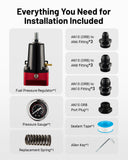
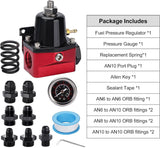
| Package Includes | Contents vary by selected configuration and may include an external 300LPH fuel pump, inline fuel filter, mounting bracket, adjustable fuel pressure regulator, adapters and applicable fittings |
| Not Automatically Included | Complete fuel hose kit, fuel rail, fuel cell, injectors, relay, fuse, wiring, pressure gauge, return line, tank fittings and vehicle-specific mounting hardware unless specifically listed in the selected package |
| Warranty | Applicable 1-year EVIL ENERGY limited warranty |
Configuration Note: Filter size, micron rating, bracket, regulator range, adapters and package contents vary by option. Review the selected variant before ordering.
Pump Selection Note: The 300LPH rating applies to the published 43 PSI and 13.5V test point. Actual fuel delivery changes with pressure, voltage, wiring, filtration, hose restriction, regulator operation and fuel type.
EVIL ENERGY Electric Fuel Pump with Regulator and Filter Kit
Building an EFI fuel system from separate parts can result in mismatched fittings, excessive filter restriction, unstable pressure, or missing mounting hardware. This configurable EVIL ENERGY EFI fuel pump kit combines a 300LPH external pump, a serviceable inline filter, mounting bracket options, and an adjustable regulator for compatible EFI conversions, engine swaps, custom fuel cells, and modified street vehicles. Choose the electric fuel pump with regulator configuration when the system requires adjustable return-style pressure control.
Filter micron rating, AN adapter size, bracket diameter, regulator range, and package contents vary by configuration. Review the selected variant before ordering rather than assuming every pump, filter, regulator, fitting, or gauge shown is included.
EVIL ENERGY EFI Fuel Filter
The EVIL ENERGY fuel filter uses an aluminum housing, removable stainless steel element, and O-ring-sealed end caps. Applicable versions are available with AN6, AN8, or AN10 adapters and optional 50 mm or 60 mm mounting brackets. This serviceable EFI fuel filter can be opened so the element can be inspected, cleaned, or replaced.
- Filtration: A selected 10-micron element is generally used as fine post-pump filtration in a compatible EFI layout.
- Flow Direction: Position the closed end of the element against the internal spring and follow the arrow on the housing. Fuel flows from the spring side toward the opposite end.
- Adapter Selection: Match the AN size to the planned fuel line, pump outlet, regulator, and available installation space.
- Fuel Compatibility: Confirm compatibility of the housing, element, O-rings, hose, pump, regulator, and fittings with the intended fuel.
The correct filter for an electric pump must protect the EFI system without creating unnecessary inlet restriction. Add a compatible coarse pre-filter before the pump when required by the complete fuel-system design.

EVIL ENERGY 300LPH External Fuel Pump
The EVIL ENERGY 300LPH fuel pump is an electric inline fuel pump for compatible 12V EFI systems. This external fuel pump for fuel injection is intended for installations designed around an externally mounted pump rather than a vehicle-specific in-tank module.
| Fuel Pressure | Voltage | Published Flow |
|---|---|---|
| 43 PSI | 13.5V | 300 LPH |
| 43 PSI | 12V | 255 LPH |
| 75 PSI | 12V | 200 LPH |
- Mount the external fuel pump close to the tank and at or below the bottom of the tank when the vehicle layout and instructions permit.
- Protect the pump from exhaust heat, drivetrain movement, road debris, and direct impact.
- Use a suitable relay, fuse, power wire, and ground, then verify voltage at the pump while it is operating.
- Match the pump to the regulator, line size, filter layout, and required flow at the intended operating pressure.
The 300LPH model name does not mean the pump delivers 300 LPH at every pressure or voltage. Select this EFI fuel pump from the published pressure-and-voltage data rather than estimating engine support from the nominal flow rating alone.

EVIL ENERGY Fuel Pressure Regulator
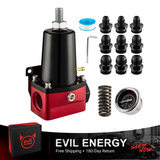
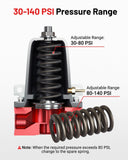
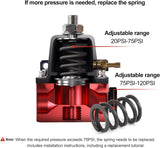
The EVIL ENERGY fuel pressure regulator controls pressure after the pump and returns excess fuel to the tank in a compatible return-style EFI system. Depending on the selected configuration, available adjustment ranges may include 20–120 PSI, 30–70 PSI, or 30–140 PSI.
- Pressure Range: Choose a range that includes the required base fuel pressure with practical adjustment room.
- Return-Style Control: Confirm the vehicle has a suitable return line and tank connection for bypass operation.
- Port Configuration: Verify the required 6AN or 10AN feed, return, gauge, and vacuum-reference ports.
- Thread Sealing: Use fuel-compatible sealant only on tapered NPT threads where required. Do not apply sealant tape to AN flare surfaces.
A fuel pressure regulator for electric fuel pump systems must match the pump flow, injector requirements, fuel rail, return capacity, and intended base pressure. A wider adjustment range does not automatically make a regulator suitable for every EFI application.


Choose the Right Fuel Pump and Filter Configuration
- Choose the fuel pump and filter configuration when a compatible regulator is already installed.
- Choose the electric fuel pump with regulator option when the EFI system needs adjustable return-style pressure control.
- Choose the appropriate filter micron rating and AN adapter size according to its position in the system and the planned fuel-line size.
- Add the correct mounting bracket when the pump or filter diameter and the available mounting area have been confirmed.
Check Before Ordering
- Required EFI base and maximum operating pressure
- Pump flow at the intended pressure and available voltage
- Fuel-line, filter, regulator, and adapter sizes
- Filter micron rating and pre-pump or post-pump position
- Regulator adjustment range, port layout, and return-line requirement
- Pump and filter mounting space and bracket diameter
- Fuel compatibility of every wetted component
- Selected variant and actual package contents
This universal-style fuel pump kit does not automatically include every hose, fuel rail, fuel cell, relay, fuse, wire, gauge, adapter, or vehicle-specific mounting component. Review the selected package before installation.
Why Choose EVIL ENERGY?
EVIL ENERGY supplies fuel pumps, filters, pressure regulators, braided fuel lines, and fittings for compatible EFI conversions, engine swaps, and custom fuel-system installations.
- Order Processing: Orders are generally processed within 1–2 business days.
- Returns: Eligible returns are handled under the current EVIL ENERGY return policy.
- Warranty: The selected kit is covered by the applicable one-year EVIL ENERGY warranty terms.
For package contents, compatibility, or installation questions, contact support@ievilenergy.com.

Moderate
Estimated Time: 1-2 hours
Tools Required
- Jack and jack stands
- Wrench set (do NOT use adjustable wrenches)
- AN fittings and thread sealant
- Drill and drill bits (for mounting bracket)
- Fuel pressure gauge (0-100 PSI)
- Bowl or bucket (for catching spilled fuel)
- Shop towels and drain pan
- Safety goggles and protective gloves
- Fire extinguisher
- Fuse puller
Pre-Installation Checklist
- Park vehicle on a flat, well-ventilated surface; post No Smoking signs
- Allow engine to cool completely before starting work
- Keep fire extinguisher within arm's reach of the work area
- Always wear safety goggles and protective gloves when installing fuel filter and fuel pressure regulator
- Make sure the vehicle is off before replacing the fuse; the fuse must be removed
- Open the fuse box and locate the fuel pump fuse, then remove it; ensure the vehicle is not in gear
- Start the engine and let it run for a minute until it stalls, confirming fuel pressure has been released
- Do not open the fuel system until pressure has been fully relieved
- Disconnect the negative battery terminal to prevent accidental engine start
- Do not start the engine again after inserting the fuel pump fuse until installation is complete
Installation Steps
- Relieve fuel system pressure: remove fuel pump fuse, start engine until it stalls, disconnect battery
- Remove the old fuel filter: if located underneath the vehicle, safely jack up and support with jack stands; place a bowl or bucket beneath to catch spilled fuel; slide the fuel filter out of its bracket
- Install the new fuel filter: identify inlet and outlet direction, position the new fuel filter in place, secure with brackets, tighten all clamps and fittings to ensure no movement or leaks
- Install the fuel pressure regulator: ensure the engine has cooled and battery remains disconnected; remove cosmetic covers to access the fuel line area; remove vacuum line from OEM regulator (if applicable); use mounting bracket as template to mark and drill mounting holes; mount regulator to the vehicle; connect fuel lines using appropriate AN fittings; attach fuel pressure gauge to the 1/8" NPT port with thread sealant; connect vacuum line to regulator for boost/vacuum reference (if required)
- Restore power and reconnect the system: lower the vehicle off jack stands; reconnect battery; turn ignition to ON (do not start) and cycle ON/OFF until fuel pressure gauge registers pressure; check for leaks at all connections; start the engine; turn clockwise to increase fuel pressure and counter-clockwise to decrease; once desired pressure is achieved, tighten the lock nut
Post-Installation Verification
- Before starting, inspect all fittings and fuel line connections for leaks
- Turn key to ON (do not start), let fuel pump run to pressurize — repeat 2-3 times until gauge shows reading
- If no fuel pressure, turn key OFF and wait one minute before cycling ON again
- Start the engine; check gauge reading and all connection points for leaks
- Adjust regulator to target pressure (turn clockwise to increase, counter-clockwise to decrease)
- Once at target pressure, tighten the lock nut
- Ensure spilled fuel is cleaned and removed from the work area
- After test drive, re-inspect all connections and confirm stable operation
- If leaks are found, turn ignition OFF, fix the issue, then retest
Troubleshooting
- No fuel pressure: check that fuel pump fuse is reinstalled, verify pump power wiring, repeat ON/OFF pressurization cycles
- Leaking at fittings: shut off engine and relieve system pressure, re-tighten or reinstall the fitting with correct o-rings
- Fuel filter installed incorrectly: confirm inlet/outlet direction markings match fuel flow direction
- Poor regulator performance: do not block vacuum port — leave open to atmosphere if vehicle has no vacuum line
- Unstable pressure: check fuel lines for air pockets, verify regulator setting, inspect filter for blockage
- Slight leakage through regulator adjustment screw: this is normal for all adjustable fuel pressure regulators and does not affect performance
Maintenance
- Visually inspect all fuel line connections every 5,000 miles or at each oil change
- Check and replace fuel filter every 15,000-30,000 miles depending on usage
- Periodically check regulator mounting bracket for tightness
- Inspect vacuum line connection (if applicable) for cracks or leaks
- Verify fuel pressure gauge reading periodically to ensure stable regulation
Brand Summary
| Policy | Details |
|---|---|
| Cancellation Policy | Orders can be canceled within 48 hours of placement. Refund processed in 3-5 business days. |
| Returns Policy | Returns accepted within 180 days. Full refund within 90 days; 15% fee for 90-180 days. |
| Non-Returnable Items | Only regular-priced items are eligible for refunds; sale items are non-refundable. |
| Refund Processing | If no refund received, check your bank/credit card. For ongoing issues, contact support@ievilenergy.com. |
Return Reasons
- Quality Issues: Provide photos/videos; we cover return shipping.
- Wrong Item Ordered: Buyer covers return shipping; email within 30 days.
- Change of Mind: Buyer covers return shipping; email within 30 days.
- Shipping Damage: Inspect packages; do not sign for damaged items.
- Incorrect Item Shipped: Contact within 7 days.
Price Protection Policy
Effective from August 25, 2024. Price drops within 7 days of purchase can be claimed.
Disclaimer
EVIL ENERGY reserves the right to interpret, modify, or terminate this policy in accordance with applicable laws and regulations.
If you need further information or assistance, feel free to ask!
Product Videos
Related Articles

How Long Does a Fuel Pump Last? Understanding Lifespan and Maintenance
When it comes to vehicle maintenance, few components are as crucial as the fuel pump. This unassuming part is responsible for delivering fuel from the tank to the engine, ensuring that your vehicle runs smoothly. But how long does a fuel pump last, and what...

How Much Should It Cost to Replace a Fuel Pump?
Facing sudden car troubles? Learn about fuel pump replacement costs in 2024 to make informed choices and avoid unexpected breakdowns.

Is Your Fuel Pump Killing Your Horsepower? 5 Reasons to Upgrade to a 300LPH System Today!
This comprehensive technical guide provides a masterclass on the installation, optimization, and maintenance of high-performance 300LPH Universal External Fuel Pumps. Designed for automotive enthusiasts and professional tuners, the article breaks down the c...

Fuel System Guide: Fix Noises, Clear Burrs, and Pro-Tips for a Clean Build
To optimize an Evil Energy fuel system, follow these three steps: 1. Use rubber isolators for vibration dampening to quiet the fuel pump. 2. Inspect AN fittings for internal burrs and clean with compressed air. 3. Perform a precise Evil Energy PTFE line ins...

The Ultimate Visual Guide to Your Car’s Fuel System & Tank Anatomy
Dive into the anatomy of performance fuel systems with this comprehensive visual guide. We explore detailed car fuel tank diagrams, the engineering behind gas tank baffles, and the plumbing essentials of car fuel line diagrams. Learn why PTFE fuel lines are...

Mastering Your Vehicle's Performance: The Ultimate Guide to the Gas Fuel System
Fuel system optimization is the heart of automotive excellence. Whether you’re prepping an LS swap or restoring a classic, understanding the mechanics of your gas fuel system is vital for reliability and power. This comprehensive guide breaks down the anato...

Carburetor to Electric Fuel Pump Conversion: Reliable Fuel Delivery
This technical guide outlines the conversion from mechanical pumps to a high-performance electric fuel pump kit for carburetor applications. Key topics include eliminating vapor locks through rear-mounted pressurization, instant system priming for faster co...
No Amazon reviews available for this product.
RELATED PRODUCTS
Example product title
- $126.73
- $126.73
- Unit price
- per
Example product title
- $126.73
- $126.73
- Unit price
- per
Example product title
- $126.73
- $126.73
- Unit price
- per
Example product title
- $126.73
- $126.73
- Unit price
- per
Example product title
- $126.73
- $126.73
- Unit price
- per
Example product title
- $126.73
- $126.73
- Unit price
- per
RECENTLY VIEWED PRODUCTS
- Choosing a selection results in a full page refresh.