


Subscribe now to unlock $9.99 deals


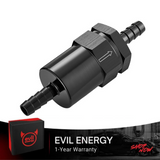

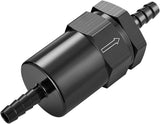
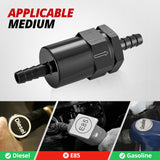
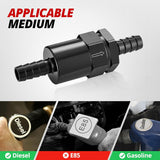
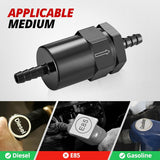
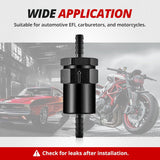
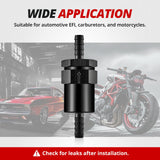
EVIL ENERGY 1/2inch,5/16inch,3/8inch Barb Billet Inline Fuel Filter 30 Micron Aluminum Black for Car EFI & Carb Fuel Systems
- $19.99
- $19.99
$19.99- Unit price
- per
SKU:
EVFS23-00107BK-010-L
Product Type:
Fuel Filters

| Specification | Details |
| Brand | EVIL ENERGY |
| Color | Black |
| Type | Inline Fuel Filter |
| Size | 1/2", 5/16", 3/8" Barb |
| Filter Element | 30 Micron Sintered Bronze |
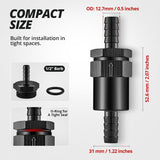
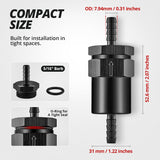
| Housing Length | 2.07 in (52.6 mm), Excluding Fittings |
| Housing Diameter | 1.22 in (31 mm) |
| Housing Material | Aluminum Alloy |
| Fuel Compatibility | Gasoline, Diesel – NOT FOR E85 |
| Fuel System Compatibility | EFI and Carburetor Fuel Systems |
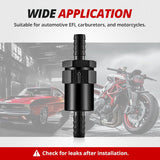
| Application | Various Vehicles, Including Cars, Motorcycles, and Boats |
Compare Inline Fuel Filters
Find the fuel filter that matches your fuel line, filter stage and available space.
 AN Billet Fuel Filter |
 Barb Billet Fuel Filter |
 3.5 Inch Fuel Filter |
 AN Inline Fuel Filter |
 Barb Inline Fuel Filter |
|
| Price | From $19.99 | From $19.99 | From $45.99 | From $23.99 | From $35.99 |
|---|---|---|---|---|---|
| Best For | Compact AN fuel lines | Compact rubber hose lines | Pre-pump filtering in tight spaces | AN fuel lines, EFI or carbureted | Rubber hose lines, EFI or carbureted |
| Connection | 6AN, 8AN or 10AN | 5/16", 3/8" or 1/2" Barb | 6AN, 8AN and 10AN | 6AN, 8AN and 10AN | 5/16", 3/8" and 1/2" Barb |
| Micron Rating | 30 Micron | 30 Micron | 100 Micron | 10, 30, 40 or 100 Micron | 10, 30, 40 or 100 Micron |
| Filter Element | Sintered Bronze | Sintered Bronze | Stainless Steel | Stainless Steel | Stainless Steel |
| Housing Length | 2.07 in | 2.07 in | 3.5 in | 4.19–5.58 in | 4.19–5.58 in |
| Housing Diameter | 1.22 in | 1.22 in | 1.97 in | 1.49–2.27 in | 1.49–2.27 in |
| Adapter Kit | One size per filter | One size per filter | Included | Included | Included |
| Shop › | Viewing now | Shop › | Shop › | Shop › |
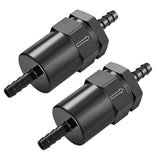
The EVIL ENERGY 30 Micron Billet Inline Fuel Filter is a small inline fuel filter for rubber fuel hose on automotive EFI builds, carbureted engines and motorcycles. A sintered bronze element sits inside a black aluminum alloy housing with 1/2", 3/8" or 5/16" barb connections. Choose a single filter or a 2-pack. NOT compatible with E85 fuel.
What Is This Small Inline Fuel Filter Used For?

This 30 micron filter helps keep rust, scale and fuel-tank debris out of carburetors, fuel pumps and small fuel passages. The compact billet body fits tight engine bays and short rubber hose runs, and it supports both EFI and carb fuel systems. A finer filter is still needed ahead of fuel injectors.
Who Uses This 30 Micron Inline Fuel Filter?

Automotive EFI, Carburetors and Motorcycles
Carbureted cars and trucks: This filter fits classic cars, hot rods and custom fuel lines between the fuel pump and carburetor.
Automotive EFI builds: On swaps and custom fuel systems, use it as a coarser stage before the pump and keep a 10 micron fuel filter kit after the pump to protect injectors.
Motorcycles: This compact motorcycle inline fuel filter suits carbureted bikes using 5/16 in hose or larger, installed between the petcock and carburetor or after an electric pump.
For an ethanol build, choose the E85 fuel filter and PTFE line kit instead.
Which Barb Size Fits Your Fuel Hose?
Measure the inside diameter of the fuel hose, then match the barb. A hose that is forced over a larger barb can split or leak, so 1/4 in fuel line should not be stretched onto the 5/16 in barb.
| 5/16"Barb | Motorcycles and Small LinesFits 5/16 in inside-diameter hose on motorcycles, small engines and smaller carbureted fuel lines. |
| 3/8"Barb | Cars and TrucksFits 3/8 in inside-diameter hose on carbureted cars, trucks and custom rubber fuel lines. |
| 1/2"Barb | Larger Custom LinesFits 1/2 in inside-diameter hose on larger custom fuel lines and higher-demand plumbing. |

Compact Billet Housing
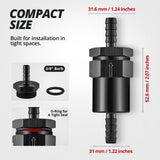
The billet housing measures approximately 2.07 in (52.6 mm) long, excluding the fittings, and 1.22 in (31 mm) in diameter. That small size makes this small in line fuel filter an excellent choice for limited space in the engine bay, along a frame rail or under a motorcycle fuel tank.
Key Features of This Small Inline Fuel Filter
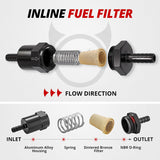
Reliable O-Ring Seal
A durable rubber O-ring creates a leak-free seal between the barb fitting and end cap. Check the connection after installation to confirm there are no leaks during operation, and check again after the first ride or drive.


Designated Flow Direction
Follow the arrow on the housing from inlet to outlet, so it points toward the carburetor or fuel pump inlet being fed.
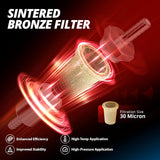
30-Micron Sintered Bronze Element
The 30-micron sintered bronze element provides uniform pores and precise filtration. It withstands high temperatures and corrosive environments, and it offers excellent durability for extended performance.


Simple Construction for Cleaning
The filter comes apart for regular cleaning, and the bronze element can be cleaned and reused. That keeps inspection simple on an older car or truck, and it can reduce motorcycle fuel filter replacement when a fuel tank starts shedding debris.
Where Does This Fuel Filter Go?
Moderate
Estimated Time: 0.5-1 hour
Tools Required
- Combination wrench set
- AN wrench set
- Drain pan
- Marker
- Drill and drill bits (if required)
- Safety glasses
- Fuel-resistant gloves
Pre-Installation Checklist
- Relieve fuel system pressure and disconnect the negative battery cable.
- Confirm the correct 10-micron or 100-micron filter and required AN6, AN8, or AN10 fittings are available.
- Identify the flow-direction arrow on the filter body.
- Place an approved drain container under the old filter and choose a mounting position away from exhaust heat and moving parts.
Installation Steps
- Disconnect the old filter fittings or clamps and remove the filter.
- Install the selected AN6, AN8, or AN10 fittings as required; do not apply thread sealant or PTFE tape to AN/ORB connections.
- Orient the new filter with its arrow pointing in the direction of fuel flow.
- Secure the filter with the supplied mounting bracket and appropriate hardware.
- Connect and tighten the fuel lines without overtightening AN fittings.
- Prime the fuel system and inspect the filter, fittings, and hoses for leaks before starting the engine.
Post-Installation Verification
- Verify the filter arrow points in the correct fuel-flow direction.
- Confirm the filter bracket, fittings, and hoses are secure and clear of heat, sharp edges, and moving parts.
- Prime the system and check for leaks before starting the engine.
- Reinspect the filter after the road test and periodically thereafter.
Troubleshooting
- Low fuel pressure: verify filter orientation and inspect for clogging or restrictions.
- Fuel leak: turn the ignition OFF, clean spilled fuel, and tighten or replace the affected fitting or hose.
- Pump noise or inlet restriction: inspect the upstream 100-micron filter and supply-line routing.
Maintenance
- Inspect the filter and connections periodically and replace a clogged or damaged filter.
- Recheck all fittings after the initial road test and after 50-100 km.
Brand Summary
| Policy | Details |
|---|---|
| Cancellation Policy | Orders can be canceled within 48 hours of placement. Refund processed in 3-5 business days. |
| Returns Policy | Returns accepted within 180 days. Full refund within 90 days; 15% fee for 90-180 days. |
| Non-Returnable Items | Only regular-priced items are eligible for refunds; sale items are non-refundable. |
| Refund Processing | If no refund received, check your bank/credit card. For ongoing issues, contact support@ievilenergy.com. |
Return Reasons
- Quality Issues: Provide photos/videos; we cover return shipping.
- Wrong Item Ordered: Buyer covers return shipping; email within 30 days.
- Change of Mind: Buyer covers return shipping; email within 30 days.
- Shipping Damage: Inspect packages; do not sign for damaged items.
- Incorrect Item Shipped: Contact within 7 days.
Price Protection Policy
Effective from August 25, 2024. Price drops within 7 days of purchase can be claimed.
Disclaimer
EVIL ENERGY reserves the right to interpret, modify, or terminate this policy in accordance with applicable laws and regulations.
If you need further information or assistance, feel free to ask!
Product Videos
No Amazon reviews available for this product.
RELATED PRODUCTS
Example product title
- $19.99
- $19.99
$19.99- Unit price
- per
Example product title
- $19.99
- $19.99
$19.99- Unit price
- per
Example product title
- $19.99
- $19.99
$19.99- Unit price
- per
Example product title
- $19.99
- $19.99
$19.99- Unit price
- per
Example product title
- $19.99
- $19.99
$19.99- Unit price
- per
Example product title
- $19.99
- $19.99
$19.99- Unit price
- per
RECENTLY VIEWED PRODUCTS
- Choosing a selection results in a full page refresh.