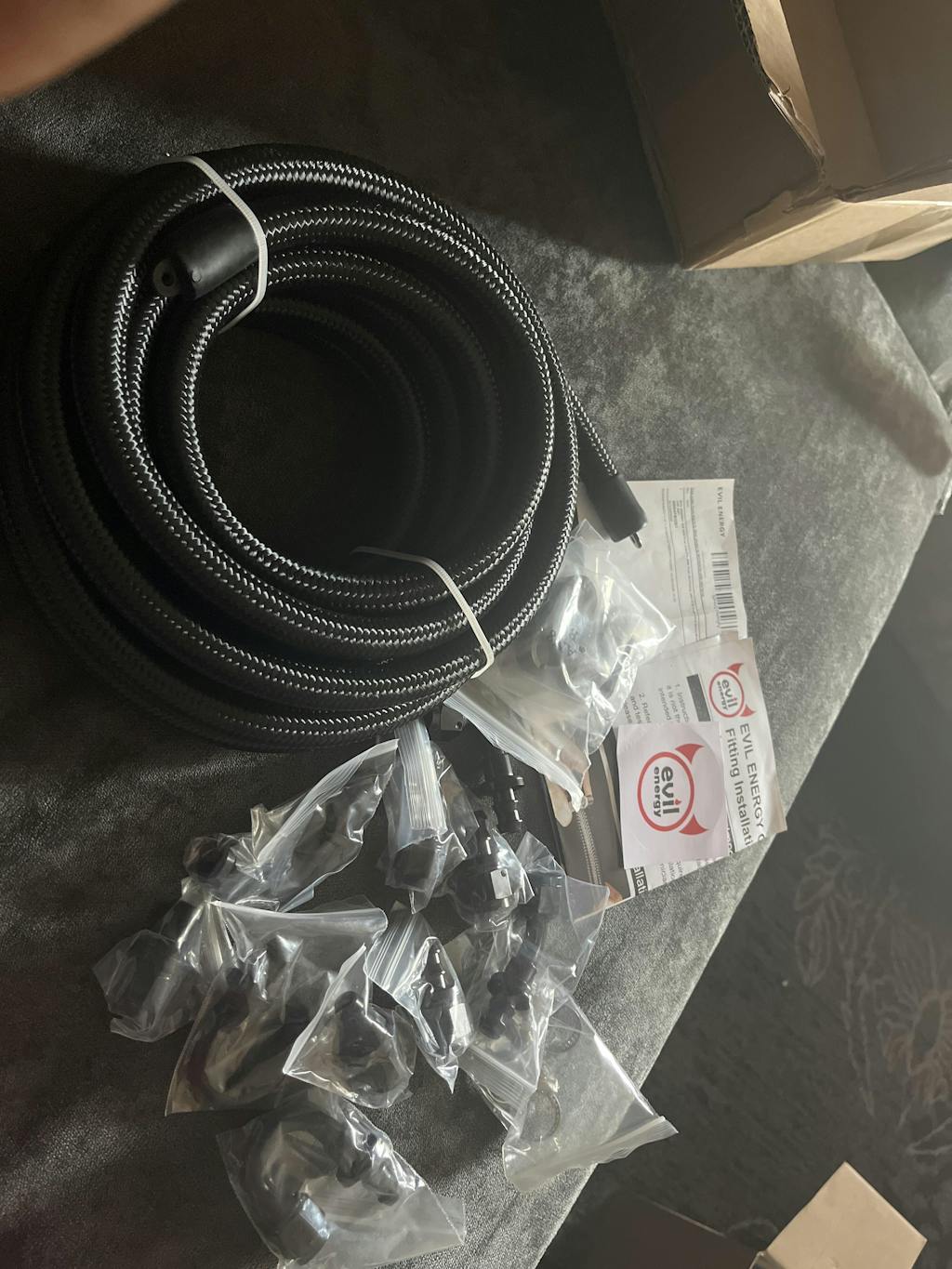
![[20FT] EVIL ENERGY PTFE Fuel Line Kit, complete black hose & fittings set, 180-day return](http://www.ievilenergy.com/cdn/shop/files/Test-2025-Evilenergy-125598065_940x.png?v=1742144807)
![[16FT] EVIL ENERGY PTFE Fuel Line Kit, black braided hose, fittings, free shipping & return](http://www.ievilenergy.com/cdn/shop/files/Test-2025-Evilenergy-125598171_940x.png?v=1742144807)
![CPE Fuel Line[25FT]](http://www.ievilenergy.com/cdn/shop/files/25FTCPE_FuelLine_940x.png?v=1735220649)
![CPE Fuel Line[20FT]](http://www.ievilenergy.com/cdn/shop/files/20FTCPE_FuelLine_940x.png?v=1735220649)





AN Fittings Guide: Types, Sizes & How to Choose

🎁 A Personal Gift For My Readers
To support your project, I've secured an exclusive 8% OFF for you.
Simply paste the code at checkout.
💡 Use the savings to grab your extra fittings, oil lines, or connectors for free!
Quick Answer
AN fittings are the standardized 37-degree flare fittings used in every performance fuel, oil, and fluid system. They deliver a leak-free, reusable connection between the PTFE fuel line, rubber hose, and hard line — something barb fittings and hose clamps can never match. Quality AN fittings use a precision 37-degree flare seat that creates a metal-to-metal seal without O-rings that can degrade with ethanol-blended fuel.
Choose AN fittings when:
-
Building a custom fuel system (EFI, carbureted, return-style)
-
Plumbing PTFE braided hose with reusable connections
-
Running high pressure (EFI 40–80 PSI) or high heat (turbo, headers)
-
Want a professional modular plumbing system you can disassemble and reuse
Not needed when:
-
Stock fuel system with OEM fittings
-
Low-pressure coolant or vacuum lines (barb fittings are fine)
For a complete overview of the fuel line types these fittings work with, start with our PTFE fuel line guide.
What Are AN Fittings?
AN ('Army-Navy') fittings use a 37-degree flare seat that creates a metal-to-metal seal when tightened. Originally developed for aerospace, they became the universal standard for performance plumbing because:
-
No O-rings to degrade — the seal is purely geometric, so there's nothing to dry out or swell with ethanol.
-
Reusable — unlike crimped ends, AN fittings can be disassembled, cut the hose, and reassembled.
-
Standardized — any brand's -6 AN fitting mates with any other brand's -6 AN port.
Every AN fitting has two parts:
-
The socket (outer sleeve) — threads onto the mating port; on hose ends, this slides over the braid. When shopping for AN hose fittings, always verify the socket is included (some budget brands sell the nipple separately).
-
The nipple (insert) — the male 37-degree flare that seats into the port; on hose ends, this inserts into the liner and uses a barbed collar to crush-seal against the PTFE liner. Quality AN fittings use billet aluminum or stainless steel here — avoid cast zinc alloys that crack under vibration.
Key point: AN fittings are not the same as NPT (pipe thread), JIC (which also uses 37-degree flare but has a different thread pitch), or barb fittings. Mixing them causes leaks.

AN Size Chart
The 'dash number' (e.g., -6 AN) refers to 1/16-inch increments of the nominal OD. Here's the complete reference:
| AN Size | Hose ID | Thread Size | Typical Fuel HP | Common Application |
| -3 AN | 3/16-inch (4.8mm) | 3/8-inch-24 | Up to 150 HP | Vacuum lines, small oil feeds |
| -4 AN | 7/32-inch (5.5mm) | 7/16-inch-20 | Up to 250 HP | Fuel return lines, carb feeds |
| -6 AN | 3/8-inch (9.5mm) | 9/16-inch-18 | Up to 500 HP | Most street performance EFI |
| -8 AN | 1/2-inch (12.7mm) | 3/4-inch-16 | Up to 750 HP | Forced induction, high-flow EFI |
| -10 AN | 5/8-inch (16mm) | 7/8-inch-14 | 750–1,000+ HP | Race engines, dual-pump setups |
| -12 AN | 3/4-inch (19mm) | 1-1/16-inch-12 | 1,000+ HP | Pro-mod, drag radial |
Sizing rule: Your PTFE fuel line AN size must match the fitting. A -6 AN fitting will not seat properly on a -8 AN hose end. For the full braided hose context, see our PTFE braided hose guide — it explains which AN hose fittings work with each hose type.
Types of AN Fittings
By Configuration
| Type | Angle | Best For | Notes |
| Straight | 0-degree | Direct runs, pump outlets | Most common; lowest flow restriction |
| 45-degree | 45-degree | Tight clearance around valve covers | Reduces need for extra hose length |
| 90-degree | 90-degree | Fuel rail inlets, regulatory outlets | Most compact routing option |
| 180-degree (U-bend) | 180-degree | Return line loops | Specialty; not needed on most builds |
By Swivel Action
| Type | Swivels? | Best For | Pros / Cons |
| Swivel | Yes (on one end) | Tight routing, multiple bends | Easier installation; slightly more expensive |
| Non-swivel | No | Straight runs | Lighter; less chance of leaking at the swivel O-ring |
Note: On reusable AN fittings for PTFE hose, the socket always swivels relative to the nipple after assembly — this is by design and is not the same as a 'swivel fitting.' A true swivel fitting has a swivel on the port side (the side that threads onto the engine/regulator). When buying AN fittings for a custom PTFE fuel line routing, swivel ends save hours of twist-correction during installation.
By Material
| Material | Finish | Best For | Pros / Cons |
| Aluminum (anodized) | Black, blue, red, gold | Most street/race builds | Lightweight; anodizing prevents corrosion; avoid in salt-belt |
| Stainless steel | Raw or polished | Marine, salt-belt, high-heat zones | Heaviest; maximum corrosion resistance; harder to find in colors |
| Billet aluminum | Raw or anodized | Show cars, high-end builds | Stronger than cast; more expensive |
How to Assemble PTFE AN Hose Ends (Step-by-Step)
AN hose fittings for PTFE line are different from rubber hose ends — they use a crush-collar seal, not a barb. When working with PTFE fuel line, always verify your fittings are the PTFE-specific type before starting. Using the wrong collar type is the #1 cause of AN fittings leaks. Follow this process exactly.
Tools Required
| Tool | Purpose |
| Bench vise with soft jaws | Hold fitting without marring |
| 1mm cutoff wheel (angle grinder) | Clean cut through braid and liner |
| Masking tape | Prevent braid fraying |
| WD-40 or assembly lube | Help liner slide over nipple barbs |
| AN wrench set | Tighten without rounding aluminum |
| Pick tool | Remove trapped braid wires from fitting |
Assembly Steps
-
Tape and mark — wrap masking tape around the hose at the cut line. Mark the cut line on the tape.
-
Cut cleanly — use a 1mm cutoff wheel. A hacksaw leaves loose braid wires that can enter your fuel system.
-
Inspect the cut — if any braid wires are frayed, trim back another 1/8-inch and re-tape. Loose wires prevent the socket from seating fully.
-
Slide the socket onto the hose — thread-end first, flared end facing the cut. The socket must be able to reach the cut end of the hose.
-
Insert the nipple — apply WD-40 to the barbed collar. Push the nipple into the PTFE liner until it bottoms against the liner's internal stop. The liner should flare slightly over the first barb.
-
Hand-tighten the socket — thread the socket onto the nipple by hand. It should spin freely for the first 3–4 turns.
-
Torque to spec — use an AN wrench to tighten 1/4 to 1/2 turn past hand-tight. Stop there. Over-tightening cracks the aluminum socket or deforms the collar beyond its sealing ability.
Pressure Test (Always Recommended)
After assembly, pressure-test before installing:
-
Cap one end of the hose with a spare AN cap.
-
Connect a fuel pressure gauge to the other end.
-
Apply 80–100 PSI shop air.
-
Hold for 10 minutes. Any pressure drop = a leak. Cut back 1/2-inch and reassemble with a new collar.
For a complete guide to the hose these fittings attach to, see our rubber fuel line overview for applications where PTFE is not required.

AN Fittings vs. Other Fitting Types
| Feature | AN Fittings (37-degree Flare) | NPT (Pipe Thread) | Barb + Hose Clamp | Push-Lock (A/C type) |
| Seal type | Metal-to-metal flare | Thread sealant required | Compression (clamp) | O-ring inside socket |
| Reusable | ✅ Yes | ❌ No (sealant bonds) | ✅ Yes | ✅ Yes |
| Fuel compatible | ✅ All fuels | ✅ With sealant | ⚠️ E85 degrades clamp seal | ⚠️ Check O-ring material |
| Pressure rating | 1,000+ PSI | 3,000+ PSI | 50–150 PSI | 250–400 PSI |
| Ease of assembly | Moderate | Easy | Easy | Easy |
| Best application | Performance fuel/oil | Block ports, NPT sensors | Low-pressure coolant | Transmission cooler lines |
Can't I just use NPT fittings with my AN fuel line? No. NPT threads are tapered and create a wedge fit sealed with thread tape or paste. AN fittings use a precision 37-degree flare. Adapters exist (AN-to-NPT), but never thread an AN fitting directly into an NPT port.
Fuel Line Compatibility: Which AN Fittings for Which Hose?
Not every AN fitting works with every hose type. Using the wrong combination causes leaks or fitting blow-off under pressure.
| Hose Type | Compatible AN Fitting Type | Fitting Construction |
| PTFE braided hose | PTFE-specific reusable AN | Crush-collar insert + swivel socket |
| Rubber fuel hose (NBR/FKM) | Barb fitting + hose clamp (not AN) | AN barb (rare) or push-lock only |
| Push-lock rubber hose | Push-lock AN fitting | Socket bites into rubber; no collar |
| Stainless braided rubber hose | Reusable AN (rubber version) | Collar crushes rubber; different from PTFE collar |
Critical: PTFE AN fittings are NOT interchangeable with rubber hose AN fittings. The collar on a PTFE fitting has a sharper barb profile designed to bite into the PTFE liner without cutting through it. Using a rubber-hose collar on PTFE causes the collar to either not seal (leak) or cut the liner (blow-out).
For the full comparison between hose types and which fittings work with each, see our PTFE vs. rubber fuel hose guide.
FAQ: AN Fittings
Q: Can I reuse AN fittings after cutting the hose off?
A: The socket (outer sleeve) is fully reusable. The aluminum collar insert is a one-time crush part — replace it every time. The nipple is reusable if it shows no cracks or galling on the 37-degree flare seat. When buying replacement AN hose fittings, always buy a fresh collar with each rebuild kit.
Q: What's the torque spec for AN fittings?
A: There is no published torque spec because AN fittings seat by feel, not torque. General rule: hand-tighten until the flare seats, then add 1/4 to 1/2 turn with a wrench. If you need a wrench to get it 'hand-tight,' something is cross-threaded. Over-tightening AN fittings cracks the aluminum and ruins the 37-degree flare seat.
Q: Do I need a swivel fitting or non-swivel?
A: Use swivel fittings anywhere the hose needs to rotate during installation (fuel rail inlets, tight spaces). Use non-swivel for straight runs where the hose won't twist during install. Most builders default to swivel for ease of installation. Quality AN fittings use a sealed bearing between the swivel and the seat to prevent vacuum leaks.
Q: Are aluminum AN fittings strong enough for EFI pressure?
A: Yes. Aluminum AN fittings are rated for 1,000+ PSI burst — far above any EFI system's 40–80 PSI operating pressure. The only reason to upgrade to stainless steel fittings is corrosion resistance (marine/salt) or extreme heat (turbo blanket proximity). For PTFE fuel line setups, aluminum is the default and stainless is optional.
Q: Can I mix AN brands?
A: Yes. The 37-degree flare and thread pitch are standardized across all AN fittings brands. A -6 AN fitting from Brand A will always mate with a -6 AN port from Brand B. This is the entire point of the AN standard, and why AN hose fittings are the first choice for custom fuel systems.
Q: What AN size do I need for my fuel system?
A:
-
Stock replacement / return line: -4 AN
-
Street performance EFI (most common): -6 AN
-
Forced induction / high HP EFI: -8 AN
-
Race / dual pump: -10 AN or larger
Still unsure? Our fuel line filters and fittings guide walks through complete system sizing.
Ready to Build Your Fuel System?
Choosing the right AN fittings for your build is the difference between a leak-free system and a fuel-smelling garage. Match the AN size to your PTFE fuel line ID, choose swivel ends for tight routing, and always pressure-test before starting the engine.
| Your Setup | Recommended AN Size | Fitting Material |
| Stock replacement, return line only | -4 AN | Aluminum (anodized) |
| Street performance, EFI, 300–600 HP | -6 AN | Aluminum or stainless |
| Forced induction, 600–900 HP | -8 AN | Stainless steel recommended |
| Race car, 900+ HP | -10 AN or -12 AN | Stainless steel |
| Marine / salt-belt | Any | Stainless steel only |
Shop Evil Energy's complete AN fittings lineup — or if you need the hose to go with them, see our guide to metal braided fuel hose for push-lock options that don't require a collar crush tool.
Still planning your full fuel system? See how to choose an electric fuel pump and our LS swap fuel system guide for complete build walkthroughs.