![[20FT] EVIL ENERGY PTFE Fuel Line Kit, complete black hose & fittings set, 180-day return](http://www.ievilenergy.com/cdn/shop/files/Test-2025-Evilenergy-125598065_940x.png?v=1742144807)
![[16FT] EVIL ENERGY PTFE Fuel Line Kit, black braided hose, fittings, free shipping & return](http://www.ievilenergy.com/cdn/shop/files/Test-2025-Evilenergy-125598171_940x.png?v=1742144807)
![CPE Fuel Line[25FT]](http://www.ievilenergy.com/cdn/shop/files/25FTCPE_FuelLine_940x.png?v=1735220649)
![CPE Fuel Line[20FT]](http://www.ievilenergy.com/cdn/shop/files/20FTCPE_FuelLine_940x.png?v=1735220649)





Bad Fuel Rail Pressure Sensor Symptoms: Is Your Sensor Faulty?
🎁 A Personal Gift For My Readers
To support your project, I've secured an exclusive 8% OFF for you.
Simply paste the code at checkout.
💡 Use the savings to grab your extra fittings, oil lines, or connectors for free!
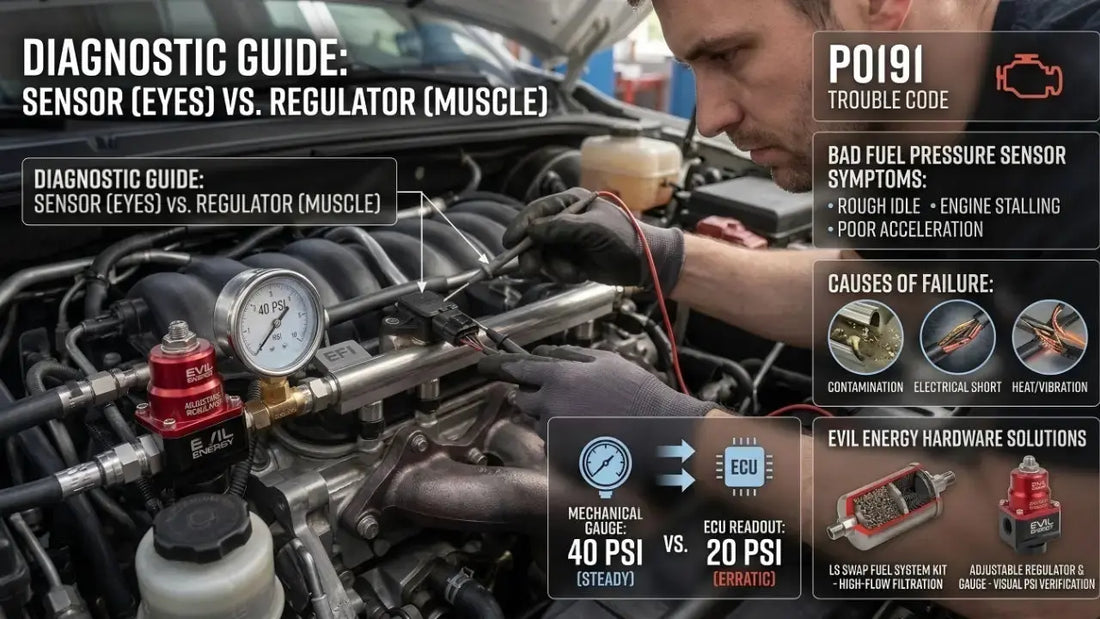
Symptoms of a bad fuel pressure sensor often mimic a failing fuel pump, including engine stalling, poor acceleration, and a rough idle. A faulty fuel rail pressure sensor sends incorrect data to the ECU, causing the engine to run too rich or too lean. If your car displays signs of a bad fuel pressure sensor, such as a P0191 trouble code, immediate diagnosis is required. Before diving into the sensor, ensure your basic pressure levels are correct by checking our Low Fuel Pressure Guide: How to Fix It.
Sensor vs. Regulator: Do You Know the Difference?
In a modern EFI system, it is easy to confuse fuel rail pressure sensor symptoms with regulator failures.
-
The Regulator (The Muscle): This is a mechanical or vacuum-operated valve that physically controls the pressure. If it fails, you get actual physical pressure drops.
-
The Sensor (The Eyes): The fuel rail pressure sensor is an electronic device that tells the ECU (the car's brain) what the pressure is.
If you have a faulty fuel rail pressure sensor, your actual fuel pressure might be perfect, but the ECU thinks it’s wrong and messes up the fuel injection timing. If you suspect the hardware rather than the electronics, see our guide on the 10 Symptoms of a Bad Fuel Pressure Regulator.
7 Major Symptoms of a Bad Fuel Pressure Sensor
When a faulty fuel sensor begins to fail, it rarely dies all at once. Look for these progressive signs of a bad fuel pressure sensor:
-
Check Engine Light (CEL): Usually triggers codes like P0190, P0191, or P0193.
-
Rough Idling: A bad fuel rail pressure sensor causes the RPM to hunt up and down while stopped.
-
Engine Stalling: The car may die suddenly when coming to a stop because the sensor fails to signal the ECU to adjust fuel for idle.
-
Poor Fuel Economy: Incorrect data leads to 'rich' conditions, wasting gasoline.
-
Hard Starting: If the fuel sensor symptoms include incorrect pressure readings during cranking, the car won't start easily.
-
Limp Mode: The ECU may limit engine power to protect the motor from a perceived fuel pressure issue.
-
Sputtering Under Load: This is common in high-performance vehicles; for specific examples, check the BMW & Duramax LB7 Fuel Pressure Regulator Symptoms Guide.

What Causes a Fuel Pressure Sensor to Go Bad?
Understanding what causes a fuel pressure sensor to go bad can help you prevent future failures. These sensors are delicate electronic components exposed to harsh environments.
-
Contamination: Microscopic debris in the fuel can clog the sensor’s sensing element. To prevent this, professional builders often upgrade to the EVIL ENERGY LS Swap Fuel System Kit. Its high-efficiency filter ensures that only clean fuel reaches your sensitive fuel rail pressure sensor, drastically extending its lifespan.
-
Electrical Short: Cracked wire insulation or corroded connectors create faulty fuel sensor symptoms.
-
Heat & Vibration: Constant exposure to engine heat eventually degrades the internal circuitry.
-
Age: Like any electronic part, they have a finite lifespan.
If you are unsure whether the sensor is lying or the pressure is actually low, you should learn how to test a fuel pressure regulator using a mechanical gauge to verify the sensor's readings.
How to Fix a Faulty Fuel Sensor Issue
If you have identified signs of a bad fuel pressure sensor, replacing the sensor is only half the battle. You must ensure the rest of the system is delivering stable pressure.
One of the most effective ways to troubleshoot a faulty fuel rail pressure sensor is to use a mechanical backup. The EVIL ENERGY Adjustable Fuel Pressure Regulator comes with a precision liquid-filled gauge. This allows you to visually verify the 'real-time' PSI against what your electronic sensor is telling the ECU. If the gauge shows a steady 40 PSI but your sensor reports 20 PSI, you know for certain the sensor is the culprit.
Recommended Solutions for Fuel System Health
A faulty fuel rail pressure sensor is often the result of an unstable fuel environment. To protect your electronics and ensure consistent performance, high-quality fuel management is essential.
For enthusiasts who want to verify their electronic sensor data against a mechanical standard, the EVIL ENERGY Adjustable Fuel Pressure Regulator is indispensable. It's built-in gauge provides a 'physical truth' to compare against the ECU's digital readings.
If you are rebuilding your fuel system to eliminate what causes a fuel pressure sensor to go bad, the EVIL ENERGY LS Swap Fuel System Kit offers premium PTFE lines and high-flow filters that keep contaminants away from your sensitive fuel rail pressure sensor.

Conclusion
Don't let fuel rail pressure sensor symptoms compromise your vehicle's reliability. Whether you're dealing with a P0191 code or engine hesitations, using premium components is the best insurance. By integrating EVIL ENERGY’s high-performance regulators and filtration kits, you eliminate the pressure fluctuations that often lead to sensor fatigue.
FAQ: Troubleshooting Fuel Rail Pressure Sensor Issues
Q1: What are the most common symptoms of a bad fuel pressure sensor?
A: The most frequent symptoms of a bad fuel pressure sensor include:
- Check Engine Light (CEL): Usually accompanied by codes like P0191.
- Rough Idling: The RPM fluctuates significantly while the vehicle is stopped.
- Engine Hesitation: A noticeable delay in power when you press the gas pedal.
- Stalling: The car may die suddenly at low speeds or stoplights.
A: This is a critical diagnostic distinction:
- The Sensor: If the physical fuel pressure is steady but the ECU reports wild fluctuations, the sensor is likely faulty.
- The Regulator: If the physical pressure is actually dropping or spiking, the regulator is failing. Pro Tip: Use an EVIL ENERGY Adjustable Fuel Pressure Regulator with its built-in mechanical gauge. By comparing the 'physical truth' on the gauge to the 'digital data' on your scanner, you can pinpoint the failure instantly.
A: Yes. A faulty fuel rail pressure sensor sends incorrect voltage signals to the ECU. If the ECU believes the pressure is too low, it may overcompensate or cut fuel delivery entirely as a failsafe, causing the engine to stall unexpectedly.
Q4: What causes a fuel pressure sensor to go bad?A: Several factors contribute to what causes a fuel pressure sensor to go bad:
- Fuel Contamination: Microscopic debris erodes the sensitive internal diaphragm.
- Heat & Vibration: Constant exposure to engine bay heat degrades the electronic circuitry.
- Electrical Shorts: Corroded connectors or cracked wiring lead to faulty fuel sensor symptoms. Prevention: Upgrading to an EVIL ENERGY LS Swap Fuel System Kit provides superior filtration and durable PTFE lines, protecting your sensor from contaminants and heat.
A: P0191 stands for 'Fuel Rail Pressure Sensor Circuit Range/Performance.' It is one of the primary signs of a bad fuel pressure sensor, indicating that the signal sent to the ECU is outside the expected operational range.
Q6: Is it safe to drive with a faulty fuel pressure sensor?A: It is not recommended. Driving with fuel sensor symptoms can lead to an improper air-fuel ratio. Running too 'rich' wastes fuel and destroys catalytic converters, while running too 'lean' can cause engine overheating and permanent internal damage.
Q7: Why does my car still have issues after replacing the sensor?A: If the sensor is new but symptoms persist, you likely have a mechanical issue or a wiring fault. Use our Low Fuel Pressure Guide to verify that your pump and lines are delivering the required PSI. If the hardware can't maintain pressure, a new sensor won't fix the problem.
Q8: How can I verify the sensor's accuracy?A: The most reliable method is a 'Cross-Check Test.' Hook up a mechanical gauge—like the one included with the EVIL ENERGY Adjustable Regulator—to the fuel rail. If the mechanical gauge reads 45 PSI but your OBDII scanner shows 20 PSI, you have confirmed a faulty fuel rail pressure sensor.
Q9: Are fuel rail pressure sensor symptoms the same for all cars?A: While the core symptoms are similar, some vehicles have specific quirks. For example, high-performance engines or diesel setups may experience more severe surging. For specialized insights, see our BMW & Duramax LB7 Fuel Pressure Guide.
Q10: How can I extend the life of my fuel rail pressure sensor?
A: Prevention is the best medicine:
- Change Fuel Filters Regularly: Keep debris away from the sensor.
- Use High-Quality Components: Lower-quality regulators can cause pressure spikes that fatigue the sensor.
- Secure Wiring: Ensure sensor harnesses are protected from excessive engine vibration.