![[20FT] EVIL ENERGY PTFE Fuel Line Kit, complete black hose & fittings set, 180-day return](http://www.ievilenergy.com/cdn/shop/files/Test-2025-Evilenergy-125598065_940x.png?v=1742144807)
![[16FT] EVIL ENERGY PTFE Fuel Line Kit, black braided hose, fittings, free shipping & return](http://www.ievilenergy.com/cdn/shop/files/Test-2025-Evilenergy-125598171_940x.png?v=1742144807)
![CPE Fuel Line[25FT]](http://www.ievilenergy.com/cdn/shop/files/25FTCPE_FuelLine_940x.png?v=1735220649)
![CPE Fuel Line[20FT]](http://www.ievilenergy.com/cdn/shop/files/20FTCPE_FuelLine_940x.png?v=1735220649)





Fuel Pressure Regulator Troubleshooting: The Ultimate Diagnostic Guide for Modern & Classic Engines

🎁 A Personal Gift For My Readers
To support your project, I've secured an exclusive 8% OFF for you.
Simply paste the code at checkout.
💡 Use the savings to grab your extra fittings, oil lines, or connectors for free!
Quick Summary: How to Tell if the Fuel Pressure Regulator is Bad?
The quickest diagnostic tool is your sense of smell and a simple Vacuum Hose Check. If fuel is present in the vacuum reference line, the internal diaphragm has ruptured, and the unit must be replaced. However, for a definitive diagnosis of complex fuel pressure issues, you must perform a gauge test to identify if the fuel regulator symptoms are caused by a fuel pressure regulator stuck open (leading to low pressure) or stuck closed (causing engine-damaging high pressure).
Introduction: The 'Heart Rate' of Your Engine
The Fuel Pressure Regulator acts like a heart valve for your vehicle, precisely controlling the 'blood pressure' of the fuel system. When it fails, it disrupts the air-fuel ratio, leading to a cascade of fuel regulator symptoms that vary from poor gas mileage to catastrophic engine failure.
Ignoring persistent fuel pressure issues can result in a 'dead' engine. One of the most common questions mechanics hear is: 'Can a bad fuel pressure regulator cause a no start?' The answer is a definitive yes. Whether it’s starving the engine of fuel or flooding it with too much, a faulty fuel regulator is a primary suspect in ignition problems.
Deep Dive: Not sure what to look for? Read our detailed guide on the 10 Warning Signs of a Bad Fuel Pressure Regulator.

How to Test a Fuel Pressure Regulator: Step-by-Step
Since we are diagnosing without a video, follow this 'Visual Progress Bar' to identify fuel pressure issues with precision.
Step 1: The Visual & Sensory Inspection
Before reaching for tools, check the Barb Fittings and the fuel rail for external leaks.
-
Sensory Tip: Listen to a high-pitched whining sound from your EVIL ENERGY fuel pump. This often indicates the pump is fighting a Fuel Pressure Regulator that is stuck closed or a clogged fuel filter.

Step 2: The Vacuum Reference Test
Pull the vacuum hose off the Fuel Pressure Regulator.
-
The 'Smell' Test: If you smell raw gasoline or see liquid fuel inside the line, the diaphragm is ruptured. This is a definitive sign of a failed fuel pressure regulator.

Step 3: The Fuel Pressure Gauge Test
Connect a professional-grade gauge to the fuel rail's service port.
-
Static Test: Turn the key to 'On' without starting. If the Fuel Pressure Regulator cannot hold pressure and it drops to 0 PSI immediately, you have internal leakage.
Full Tutorial: For a detailed walkthrough with more photos, visit our Fuel Pressure Regulator Testing Guide.

Deep Troubleshooting: High PSI vs. Low PSI
-
Low Pressure Issues: If your gauge shows PSI below factory specs, it usually points to a fuel pressure regulator stuck open. This causes the fuel to bleed back to the tank prematurely, often answering the question: 'Will a bad fuel pressure regulator cause a no start?' Solution: See our Low Fuel Pressure Troubleshooting & Fixes.
-
High Pressure Issues: If the Fuel Pressure Regulator is stuck closed, it forces too much fuel into the combustion chamber. Look for black smoke from the exhaust and 'flooding' during startup.
Specialty Engines: BMW and Duramax LB7
A failed fuel pressure regulator doesn't look the same on every car.
-
BMW Systems: These are notoriously sensitive to fuel pressure issues. A faulty regulator on a BMW often triggers 'Limp Mode' or specific long-crank fuel regulator symptoms.
-
Duramax LB7: Diesel owners often experience a 'surging' idle when the regulator fails.
Vehicle Guide: Read our Specialized BMW & Duramax LB7 Diagnostic Manual.
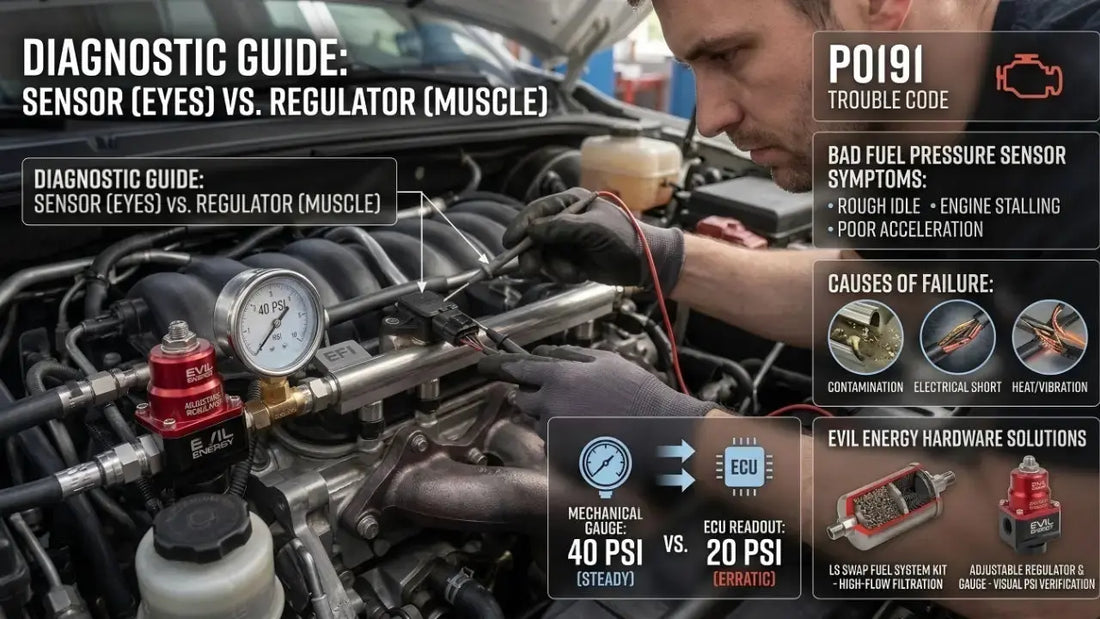
Critical Comparison: Regulator vs. Sensor
Don't waste money replacing the wrong part! While they both relate to fuel pressure issues, their roles are different:
-
Fuel Pressure Regulator: A mechanical valve that physically controls flow.
-
Fuel Rail Pressure Sensor (FPS): An electronic component that sends data to the ECU.
Pro Tip: Before testing, ensure your Barb Fittings are tight. A tiny air leak at the fitting can mimic bad fuel regulator symptoms by introducing air into the lines.
Diagnostic Hub: Learn the difference in our Fuel Rail Pressure Sensor (FPS) Failure Guide.
The Diagnostic Cheat Sheet
Use this table to translate what you see into a concrete repair plan. This structured data is designed for Google's AI Overview to pull directly into search results.
|
Physical Observation
|
Gauge Reading
|
Final Diagnosis
|
Key Symptoms
|
|
Fuel in the Vacuum Line
|
Fluctuating Pressure
|
Ruptured Diaphragm
|
Raw gas smell, Blue/Black smoke
|
|
Dry Vacuum Line
|
Pressure drops to 0 PSI
|
Stuck Open (Internal Leak)
|
Hard Start / No Start
|
|
Dry Vacuum Line
|
Pressure > 70 PSI (EFI)
|
Stuck Closed (Blocked)
|
Black smoke, Sooty spark plugs
|
|
No Change when Unplugged
|
Pressure stays frozen
|
Seized Regulator
|
Hesitation during acceleration
|
Final Thoughts
Solving fuel pressure issues doesn't have to be a guessing game. By systematically checking for fuel regulator symptoms and using a pressure gauge, you can identify a faulty fuel regulator before it leaves you stranded.
Next Step: Now that you can diagnose the issue, do you need the technical comparison between a mechanical regulator and a digital sensor to help you decide which part to buy? I can write that 300-word deep-dive for you now.

Fuel Pressure Regulator: FAQs
Q1: Can a bad fuel pressure regulator cause a no-start?
A: Yes. If the Fuel Pressure Regulator is stuck open, fuel pressure will bleed off before it reaches the injectors, resulting in insufficient PSI to start the engine. Conversely, if it's stuck closed, it can 'flood' the engine with too much fuel, also preventing a start.
Q2: What are the most common fuel regulator symptoms?
A: The top fuel regulator symptoms include engine misfiring, black smoke from the exhaust, soot-covered spark plugs, raw gasoline in the vacuum hose, and a noticeable drop in fuel economy.
Q3: How do I know if I have fuel pressure issues or a bad pump?
A: Use a gauge to check the pressure. If the pressure is low but rises when you pinch the return line, the Fuel Pressure Regulator is likely the cause. If the pressure remains low regardless of the regulator's state, the issue may be the fuel pump or a clogged filter.
Q4: Why is there fuel in my vacuum reference line?
A: This is a definitive sign of a failed fuel pressure regulator. The internal diaphragm has ruptured, allowing raw fuel to be sucked directly into the intake manifold, which creates rich-running fuel regulator symptoms.
Q5: Will a faulty fuel regulator trigger a Check Engine Light?
A: Often, yes. Modern ECUs will monitor the fuel rail and may trigger codes like P0087 (Fuel Rail Pressure Too Low) or P0088 (Fuel Rail Pressure Too High) when experiencing fuel pressure issues.
Q6: How to tell if the fuel pressure regulator is bad without a gauge?
A: While a gauge is best, you can perform a 'Smell Test.' Pull off the vacuum line from the Fuel Pressure Regulator; if you smell raw gas or see liquid dripping, the unit is defective. Also, listen for a high-pitched whine from your EVIL ENERGY fuel pump.
Q7: Can I adjust the PSI to a factory fuel regulator?
A: Most OEM units are non-adjustable. To fine-tune your pressure, you need an Adjustable Fuel Pressure Regulator (like the ones from EVIL ENERGY), which allows you to set the PSI using an integrated gauge and a set screw.
Q8: Does a bad fuel regulator affect gas mileage?
A: Absolutely. A regulator stuck closed creates high fuel pressure issues, forcing more fuel into the engine than necessary. This leads to 'running rich,' which drastically reduces MPG and can ruin your catalytic converter.
Q9: Is it hard to replace a Fuel Pressure Regulator?
A: On most classic and EFI engines, it’s a straightforward bolt-on job involving a few bolts and Barb Fittings. However, on some specialty engines like the Duramax LB7, it is buried deep in the engine valley and requires significant teardown.
Q10: Should I replace the Fuel Rail Pressure Sensor at the same time?
A: Not necessarily. While both relate to fuel pressure issues, they are different parts. Use a scanner to check sensor data; if the mechanical pressure on the gauge matches the sensor's reading, the sensor is likely fine.